
Whoscall Releases Annual Report: Hong Kong Scam Drop 27% YoY; "Finance & Investment" Nuisance Calls Top the List at Nearly 60%
HONG KONG, Feb. 24, 2026 /PRNewswire/ -- Whoscall, the leading digital anti-scam App under TrustTech provider Gogolook, today released its 2025 Annual Report. For the first time, the report provides a deep dive into Hong Kong's digital scam landscape, covering risks across phone calls, malicious links, and personal data leaks. Data reveals that the total number of phone and SMS scams in Hong Kong recorded a significant 27% year-on-year (YoY) decrease in 2025, placing it alongside Taiwan as the only regions in Asia to see a cooling trend. However, Whoscall warns that despite the overall decline, cross-border scams and targeted "Finance & Investment" nuisance calls remain severe, urging citizens to stay highly vigilant.
Scam Landscape in Asia: Thailand Tops Volume While HK and Taiwan Record Declines
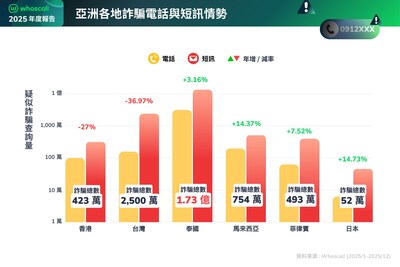
Global scam surged in 2024, with scam syndicates constantly evolving their tactics. According to Whoscall's latest data, the app identified over 6 billion unknown calls and SMS messages globally in 2025. Among these, 480 million were identified as scams (approx. 8%), including 79.83 million suspected scam calls and 400 million suspected scam SMS. Regionally, Thailand remains the most targeted in Asia with a staggering 173 million scams, continuing to grow by 3.16%.
In Hong Kong, the total number of scams was 4.23 million, down 27% YoY. This reflects the successful synergy between government crackdowns and public education. Taiwan saw a 36.97% drop (approx. 25 million scams), the most significant decrease in Asia. Conversely, scams in the Philippines (+7.52%), Malaysia (+14.37%), and Japan (+14.73%) continue to rise. Whoscall notes that as scam shifts from domestic to cross-border operations, global cooperation is vital to combat digital crime.
While Hong Kong's "SMS Sender Registration Scheme" (where registered senders use the "#" prefix) effectively identifies local legitimate enterprises, Whoscall reminds the public that the scheme primarily covers local senders. Many Mainland or cross-border enterprises have not joined the scheme, creating a "grey area" for scammers to send phishing links. As one of the few apps providing comprehensive SMS protection, Whoscall's "SMS Assistant" feature automatically scans and filters messages containing suspicious links, safeguarding users against cross-border risks not covered by the registration scheme.
Hong Kong Nuisance Call Rankings: Finance & Investment Leads the Pack
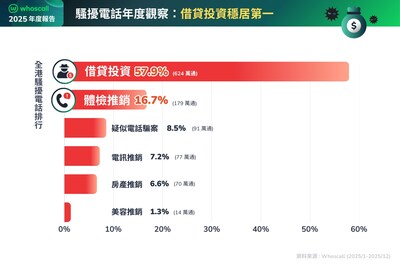
Communication nuisance in Hong Kong is highly concentrated. The "Finance & Investment " category dominates with 6.24 million identified calls, accounting for nearly 58% of total nuisance calls. Analysis shows these calls often originate from non-bank outsourced telemarketing, debt restructuring services, and financial intermediaries.
Ranked second is "Health Checkup Promotions" at 1.79 million calls (16.7%), often marketing low-cost checkups or health seminars. Whoscall points out that telemarketers utilize auto-dialing systems paired with low-end AI pre-recorded messages for "carpet-bombing" marketing, causing significant daily disturbance. Users can effectively filter these high-frequency nuisance calls using Whoscall's real-time identification.
Notably, "Scams & Impersonations" ranked third with over 910,000 calls (8.5%). These include malicious numbers frequently reported or blocked by the community. Data shows scam syndicates often alternate between impersonating finance companies and government officials to "test" potential victims. Other major sources include "Telecom Service Telemarketing" (770,000), "Real Estate Marketing" (700,000), and "Beauty Telemarketing" (140,000).
One Click to Danger: Malicious Software and Phishing Links Exceed 70%
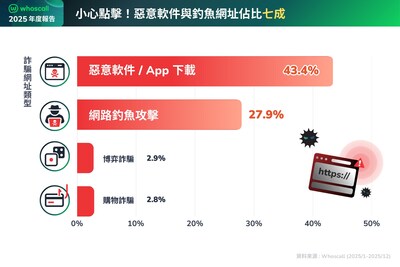
As scam extends to digital links, malicious URLs have become high-risk channels. The report identifies "Malware/App Downloads" as the most prevalent malicious link type (43.4%), followed by "Phishing" (27.9%). Together, they exceed 70%. These links often masquerade as "Unpaid Utility Bills," "Account Verification," or "Logistics Tracking," utilizing AI-generated content to appear highly authentic. Once clicked, they may install background malware or trick users into entering passwords and OTPs, leading to long-term security risks.
To combat scam on social media and messaging apps, Whoscall introduced its "Check" feature. Beyond checking unknown numbers or links, users can simply upload screenshots of suspicious conversations or ads from platforms like WhatsApp, Facebook, or WeChat. Whoscall's specially trained AI model instantly analyzes the content to provide risk alerts and advice.
Data Leak Risks: Hong Kong Remains High at 65.72%
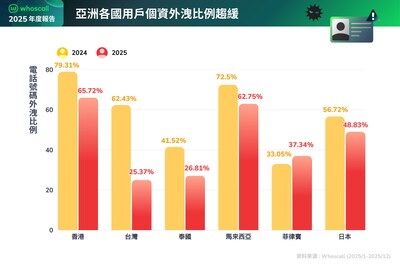
While the trend of data leaks in Asia has slowed, Hong Kong's phone number exposure rate remains at a high 65.72%, significantly higher than other Asian regions. Whoscall emphasizes that leaked phone numbers often serve as the starting point for phone scams and phishing SMS. Citizens are encouraged to use Whoscall's "ID Security" feature to stay informed of their privacy risks.
Whoscall states that anti-scam efforts have entered a cross-border, multi-channel era. As the most feature-rich identification tool in the Hong Kong market, Whoscall will continue to leverage AI and big data to protect every user's communication safety.
About Whoscall
The Whoscall app, a Caller-ID & digital anti-scam tool, is designed to protect users across various scenarios from scams and spams, including phone calls, text messages, and links. With over 100 million downloads worldwide, it boasts the most comprehensive database in East and Southeast Asia, encompassing over 2.6 billion phone numbers, and collects data from partner HKJunkCall and ScamAdviser to form a leading digital anti-scam database. The Whoscall team has been dedicated to developing anti-scam technology for over a decade, employing AI to analyze and simulate the patterns of scam groups, proactively preventing the spread of scams. At the same time, Whoscall actively engages in building a community collaboration mechanism with its users, playing a role with societal impact in digital anti-scam services from educational initiatives, cross-sector collaboration to product innovation. Whoscall has won multiple Google Play and App Store Best App of the Year awards. With the brand vision of 'Innovating for Trust, Powered by People,' it serves as a socially impactful digital innovation service, and recognized and chosen for partnerships by the OFCA, Taiwan National Police Agency, Thai Royal Police and NCSA, Royal Malaysia Police and CyberSecurity Malaysia, the Philippines Cybercrime Investigation and Coordinating Center, and local governments in Japan.
 View original content to download multimedia:https://www.prnewswire.com/apac/news-releases/whoscall-releases-annual-report-hong-kong-scam-drop-27-yoy-finance--investment-nuisance-calls-top-the-list-at-nearly-60-302694568.html
SOURCE Whoscall

- HOT NEWS
- CIMB Singapore Recognised as a Top Employer and "Career Builder" in Inaugural Singapore Opportunity Index
- How Lee Junho’s Typhoon Family Turned a K-Drama Into a Real-World Brand
- IVE Dive Into a New Era With ‘Blackhole’ Concept Photos for REVIVE+
- LG ELECTRONICS PRESENTS THE FUTURE OF LUXURY HOME LIVING AT KBIS 2026
- Yokohama announced as site of new Ericsson Japan R&D Center


허블 정보
Copyright © 2017 Huvle All Rights Reserved
admin@huvle.com