
Can HYBE’s New Latin Group Santos Bravos Become Its Boldest Bet Yet?
HYBE’s latest music experiment is no longer just an industry idea. It now has a face, a sound, and a growing international audience.
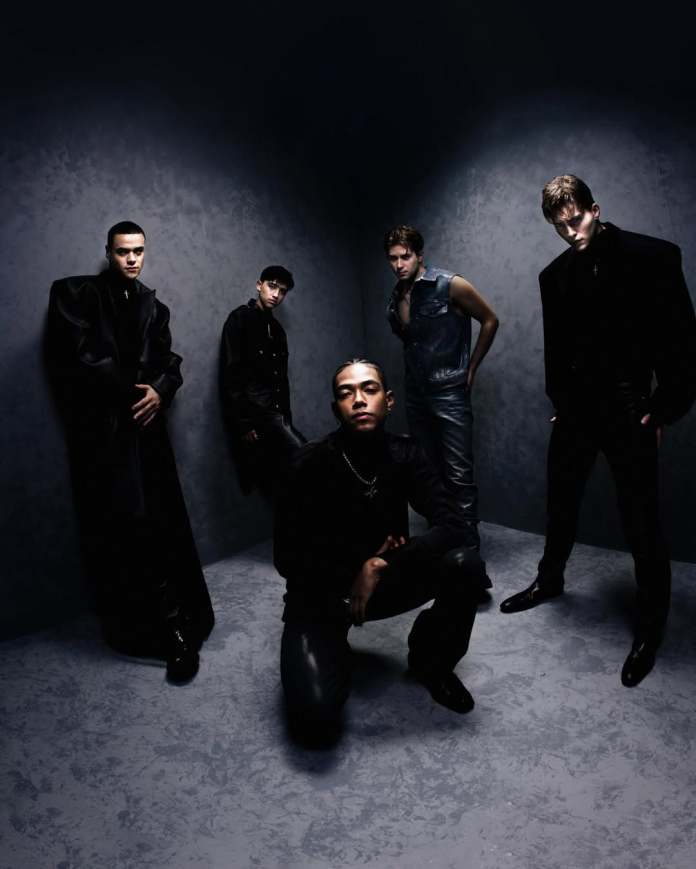
That face is Santos Bravos, a five-member Latin group created under HYBE Latin America, and their pitch is as ambitious as it is unusual: take the discipline and structure of the K-pop system, fuse it with Latin pop and club energy, and build something that feels global from the start.
A Group Built Across Borders
At a media showcase held on April 10 at HYBE’s headquarters in Yongsan, Seoul, the group spoke openly about their identity, their training, and why this moment in Korea matters so much to them. If their debut phase was about proving the concept could work, this visit feels more like the next step proving it can travel.
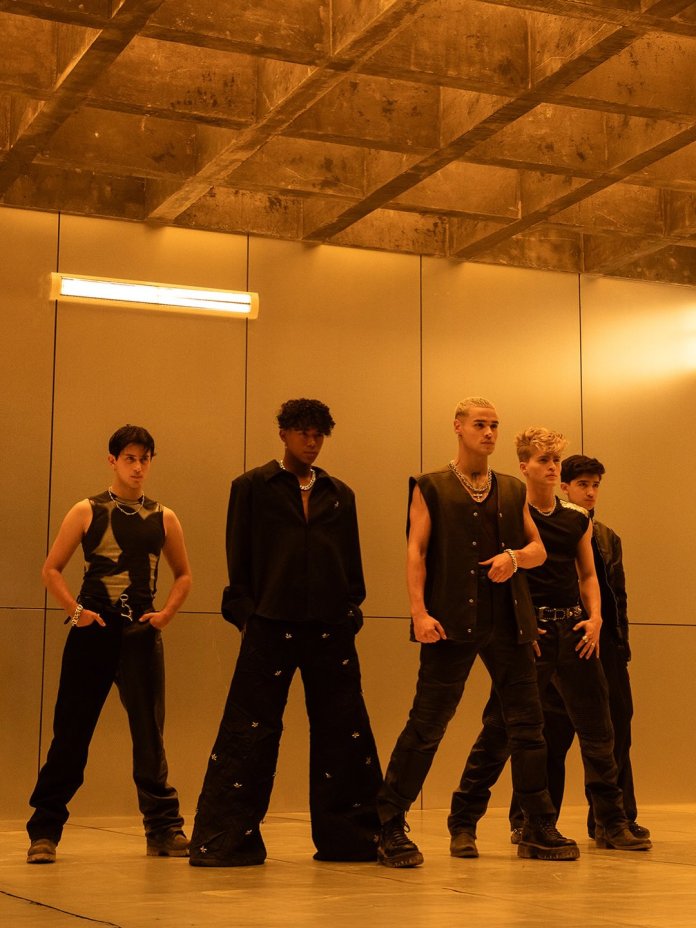
Santos Bravos consists of Drew (U.S./Mexico), Alejandro (Peru), Kauê (Brazil), Gabi (Puerto Rico), and Kenneth (Mexico). Their backgrounds are different, but that diversity is not treated as a side note. It is the core of the group’s appeal.
The members said they came into the project with the mindset of representing their countries while also connecting people across borders. That idea is reflected not just in their lineup, but in the music itself. Their songs naturally blend Spanish, English, and Portuguese, creating a sound designed to feel multilingual and international rather than limited to one market.
That is where the HYBE model enters. The group has paired those cultural influences with K-pop-style training, giving the project a level of polish and performance structure that the members clearly see as a major advantage.
From Bootcamp to Bigger Stages
he road to debut was not simple.
Drew revealed that the project began with 16 trainees, with the final lineup of five taking shape after roughly six months of bootcamp. He described it as an intense period that forced him to push past his own limitations. That intensity seems to have paid off quickly. Even before reaching the one-year mark, Santos Bravos have already stepped onto high-profile stages and begun building the kind of resume many rookies spend years chasing.
The group recently released its first EP, ‘DUAL’ and has already appeared at Paris Fashion Week and major music festivals in Mexico, Colombia, and Guatemala. Kenneth said one of the most unforgettable milestones came when the group’s debut show in Mexico sold out 10,000 seats, a moment he said he never imagined arriving so early.

Their first EP, ‘DUAL,’ appears designed to explain exactly who they are.
Kauê described it as a special project that introduces their sound through different emotions and colors. The album uses the group’s own name as a thematic frame: “Santo” for softness and “Bravo” for intensity. In other words, Santos Bravos are presenting themselves through emotional duality rather than a single fixed tone.
Drew said the group wanted to express the reality that everyone moves through different feelings, comparing the listening experience to an emotional roller coaster.
Korea as the Next Test
Their current stay in Korea carries symbolic weight.
The group is expected to spend around three weeks taking part in music shows, radio appearances, and other promotional schedules, effectively stepping into the K-pop ecosystem more directly than before. For the members, that matters because Korea is not just another stop. It is the origin point of the system that shaped them.
Gabi called the Korean market HYBE’s root and said standing on this stage was something the group had worked toward continuously. Drew added that he came with the mindset of a student, saying he is learning from label seniors such as TWS, LE SSERAFIM, and ILLIT.
Kenneth also said every moment in Korea feels meaningful, while Alejandro shared his surprise at how familiar Korean audiences already seemed with Latin music. He recalled a recent Idol Radio appearance where Gabi sang a Bad Bunny song and the crowd sang along, a small but telling sign that the crossover they are chasing may not be as difficult as it once seemed.
Editor’s Insight
What makes Santos Bravos interesting is that they are not being presented as Latin artists borrowing from K-pop or as a K-pop act simply translated into another region. Instead, the group is being framed as something in between or perhaps something new entirely. The members speak about representing their individual countries, but also about becoming a group people can rely on, admire, and connect with beyond nationality. Because if Santos Bravos succeed, the story will not just be that HYBE launched another group. It will be that one of K-pop’s biggest companies found a way to build a new kind of global pop act one that does not erase differences, but turns them into the foundation.
- HOT NEWS
- The “Idol of Idols” Makes History: Taemin Becomes First Korean Male Soloist to Grace the Coachella Stage
- Central Pattana Announces $3 Billion Investment to Expand Mixed-Use Developments Across Thailand
- CICPE in Haikou draws record global participation
- WPS 365 Debuts Three B2B Strategies at GITEX ASIA 2026 Amid APAC AI Office Boom
- 2026 Kia CEO Investor Day: Kia to Drive Exponential Growth and Manufacturing Innovation by Expanding Its Full Electrified Vehicle Lineup and Strengthening Future Business Capabilities

![[Analysis] The “Lee Junho Effect” Holds Firm: Why the Multitalented Star Remains an Unstoppable Force in the 2026 Rankings](https://i0.wp.com/wikipickymedia.com/wp-content/uploads/2026/04/lee-junho-44.png?resize=696%2C869&ssl=1)

허블 정보
Copyright © 2017 Huvle All Rights Reserved
admin@huvle.com