
Can You Earn a Degree in South Korea Without Speaking Korean? The Answer Is More Complicated Than It Looks
Some Korean universities offer genuinely English-medium degrees, but an English admission track does not always mean every class, requirement, or part of campus life will be available in English.
South Korea is attracting a growing number of international students with scholarships, globally recognized universities, and degree programs advertised in English.
For an applicant searching from abroad, the offer can seem straightforward: submit an English proficiency score, enter an international program, and complete a Korean university degree without needing advanced Korean.
In some programs, that is entirely possible.
Yonsei University’s Underwood International College states that all of its courses are conducted in English. KAIST describes English as its main language of instruction, while English-medium international studies programs are also available at institutions including Korea University and Ewha Womans University.
But across the wider university system, the phrase “English-taught” can describe several very different realities.
A university may offer a selection of courses in English without offering an entire degree in English. A department may conduct most lectures in English while retaining Korean-language graduation requirements. A program may be academically accessible in English even though course registration, administration, internships, group projects, and daily campus life continue largely in Korean.
For prospective students, the important question is therefore not simply whether a university offers English classes.
It is whether the exact degree can be completed from admission to graduation without depending on Korean-language courses.
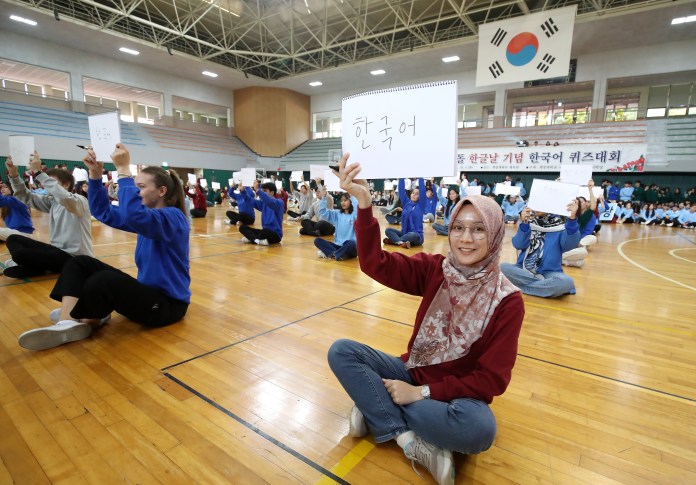
English admission does not always mean an English degree
One of the easiest mistakes applicants make is assuming that permission to apply with an English test score proves that the degree itself is taught in English.
At Seoul National University, for example, international applicants can demonstrate proficiency through either Korean or English qualifications. The university lists options including TOPIK for Korean and TOEFL, IELTS, or TEPS for English.
That makes admission possible for students who do not yet speak Korean. It does not, however, establish that every major at the university can be completed entirely in English.
The same distinction applies across Korean higher education.
The Korean government’s Study in Korea portal allows prospective students to search for universities and English-taught courses. However, finding English courses at a university is not the same as confirming a complete English-medium curriculum.
An applicant may discover that enough English courses are available during one semester but not during another. Required major classes may be offered only in Korean, or English sections may fill quickly during registration.
Before applying, students need to distinguish between three descriptions:
- A university offering some courses in English
- A major offering most required courses in English
- A complete English-track degree with all graduation requirements available in English
Only the third reliably answers the question.
Some programs make a clear commitment
There are Korean programs that explicitly present English as their language of instruction.
Yonsei University’s Underwood International College, for example, states that all courses are conducted in English. Its majors include economics, international studies, political science and international relations, comparative literature and culture, and several interdisciplinary fields.
KAIST also says that English has served as its main language of teaching since 2008. The university’s international graduate admissions materials identify English as the official language of communication and instruction for international students. This creates a substantially different academic environment from enrolling in a conventional department that happens to offer several English lectures.
At Korea University’s Graduate School of International Studies, the university states that all courses in its master’s program are taught in English. Ewha Womans University similarly describes its International Studies program as offering English-medium courses in international trade, business, development cooperation, and international relations.
These programs demonstrate that completing a Korean degree academically in English is not merely a marketing promise. It is a real possibility.
The answer still depends on the specific college, department, concentration, and year of admission.
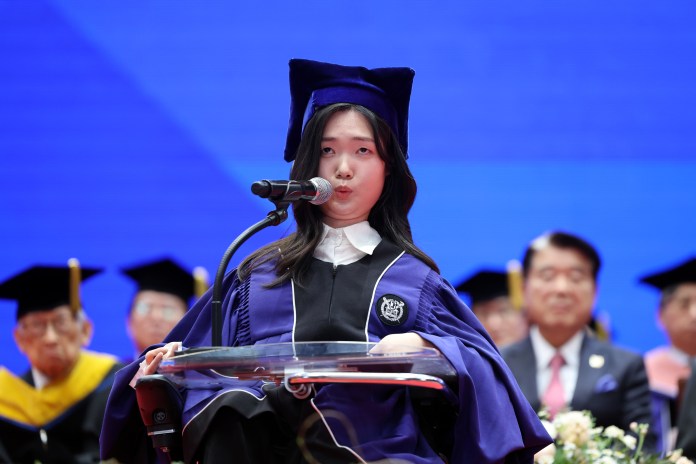
Graduation requirements can reveal the hidden difference
Even when coursework is mainly offered in English, students should examine graduation requirements separately.
A program may require:
- A Korean-language test or course
- A second foreign-language qualification
- General education classes outside the English track
- A thesis defense governed by separate language rules
- Mandatory classes offered in limited English sections
- Internships or fieldwork conducted primarily in Korean
Seoul National University’s Graduate School of International Studies, for example, says its master’s courses are mainly conducted in English. Its academic regulations have also included foreign-language requirements that vary according to degree, nationality, and major.
That does not mean the degree cannot be completed in English. It shows why applicants must read the current academic regulations rather than relying only on the admissions homepage.
The most reliable evidence is not a general statement that a university is “global.” It is a semester-by-semester course catalog and a written list of graduation requirements for the applicant’s exact major.
The language of the classroom is only part of the experience
A student may be able to write every assignment in English and still encounter Korean throughout university life.
Administrative announcements, department group chats, student clubs, career events, counseling services, and internship recruitment may not always provide complete English-language support. Group projects can also shift naturally into Korean when most team members are Korean.
The difficulty can extend beyond campus.
Opening a bank account, signing a housing contract, visiting a hospital, arranging a phone plan, and completing immigration procedures can require Korean or assistance from someone who speaks it. Universities generally operate international offices, but those offices cannot accompany students through every part of daily life.
This creates two different questions:
Can the degree be completed academically in English?
and:
Can the entire experience of studying and living in Korea be managed comfortably without Korean?
For carefully selected English-track programs, the answer to the first may be yes. The answer to the second is far less certain.
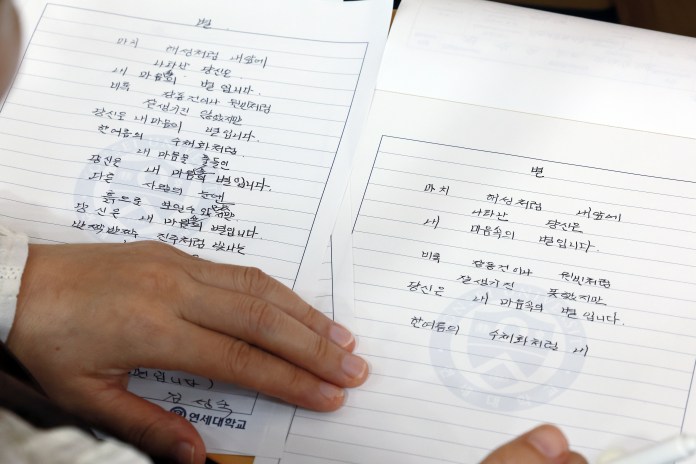
Five questions every applicant should ask
Before accepting an offer, international applicants should contact the department directly and request written answers to the following:
1. Are all required major courses taught in English?
Do not ask only what percentage of total university classes is offered in English. Ask about the mandatory courses for the exact degree.
2. Have those courses been offered consistently?
A course listed in an English catalog may not be available every semester or every year.
3. Can general education requirements also be completed in English?
A major may be English-medium while university-wide requirements are not.
4. Are there Korean-language or foreign-language graduation requirements?
Check test requirements, mandatory language classes, thesis regulations, and exemptions for international students.
5. Can the university confirm that a student with no Korean proficiency has graduated from the program?
This is often more revealing than promotional wording.
Applicants should also request recent course schedules and speak with at least one currently enrolled international student. Admissions offices explain official policy. Students can explain how that policy functions in practice.
So, is it really possible?
Yes, an international student can complete certain degrees in South Korea entirely, or almost entirely, in English.
The strongest options are programs that explicitly identify themselves as English-medium and publish clear curricula and graduation requirements. International colleges, graduate schools of international studies, and science and technology institutions are among the most likely places to find them.
But the phrase “English-taught” should never be accepted without further investigation.
At some universities, it means a complete academic pathway. At others, it means only a collection of English lectures inside a system that still expects students to navigate important requirements in Korean.
The difference may not become obvious until course registration begins.
For students considering several years of study abroad, checking that distinction before applying can prevent one of the most consequential surprises of their university experience.
- HOT NEWS
- Mark reveals daily life in New Jersey... from childcare, basketball, to singing at his brother's house
- ENHYPEN Never Abandoned Their Vampire Story Six Years Later, It Has Become Their Signature
- Jungkook ranks first in mentions of X this year with 2.6 million, overwhelming others, announced by the World Music Awards
- Kim Jae-joong Makes Big Screen Return After 14 Years in Ghost Horror Film ‘The Shrine’
- Natuvion IT Transformation Report: 76 Percent of Companies Rely on AI for Data Migration

![[이란인의 한국살이]](https://cdnweb01.wikitree.co.kr/webdata/editor/202607/01/202607011649454994.jpeg)

허블 정보
Copyright © 2017 Huvle All Rights Reserved
admin@huvle.com