
Lee Min-ho’s ‘Assassin(s)’ Tops Korean Film Reservation Chart After Rapid Box Office Rise
The political mystery thriller surpassed one million admissions within four days, while Lee Min-ho’s performance as an unconventional rookie reporter is emerging as one of the film’s major attractions.
Lee Min-ho’s latest film “Assassin(s)” is maintaining its box office momentum after the Chuseok holiday.
According to the Korean Film Council’s integrated ticketing system, “Assassin(s)” ranked first among Korean films in real-time reservations as of 7 a.m. KST on September 29.
The achievement follows a strong opening period for the mystery thriller, which reached one million admissions only four days after arriving in Korean theaters on September 23. By the morning of September 28, the film had recorded more than 1.5 million admissions and secured first place at the domestic box office during its opening week.
While the project features a prominent ensemble led by Yoo Hae-jin, Park Hae-il and Lee Min-ho, the film also gives Lee an opportunity to display a looser and more unpredictable style of acting.

Lee Min-ho Plays a Rookie Reporter Searching for the Truth
“Assassin(s)” is inspired by the 1974 assassination attempt against then-President Park Chung-hee, which resulted in the death of first lady Yuk Young-soo.
Rather than presenting the incident as a straightforward historical reconstruction, the film begins with questions about whether the publicly known version of the event contains the complete truth.
Lee Min-ho plays Young-il, a rookie reporter in the social affairs department of a newspaper. He joins veteran journalist Jae-hwan, played by Park Hae-il, and detective Cheol-gu, played by Yoo Hae-jin, as they follow evidence surrounding the shooting and its possible organizers.
Young-il is not portrayed as a conventional nervous newcomer. He is confident, socially skilled and willing to use his privileged background to obtain information. At the same time, he possesses the fearlessness of a young journalist who has not yet learned to retreat when confronted by authority.
Lee previously described the character as being like a “live fish,” explaining that he wanted Young-il to inject movement and energy into the film.
That approach creates a contrast with the more experienced characters around him. While Jae-hwan carefully organizes information and Cheol-gu pursues leads directly in the field, Young-il brings instinct, boldness and unpredictability to the investigation.
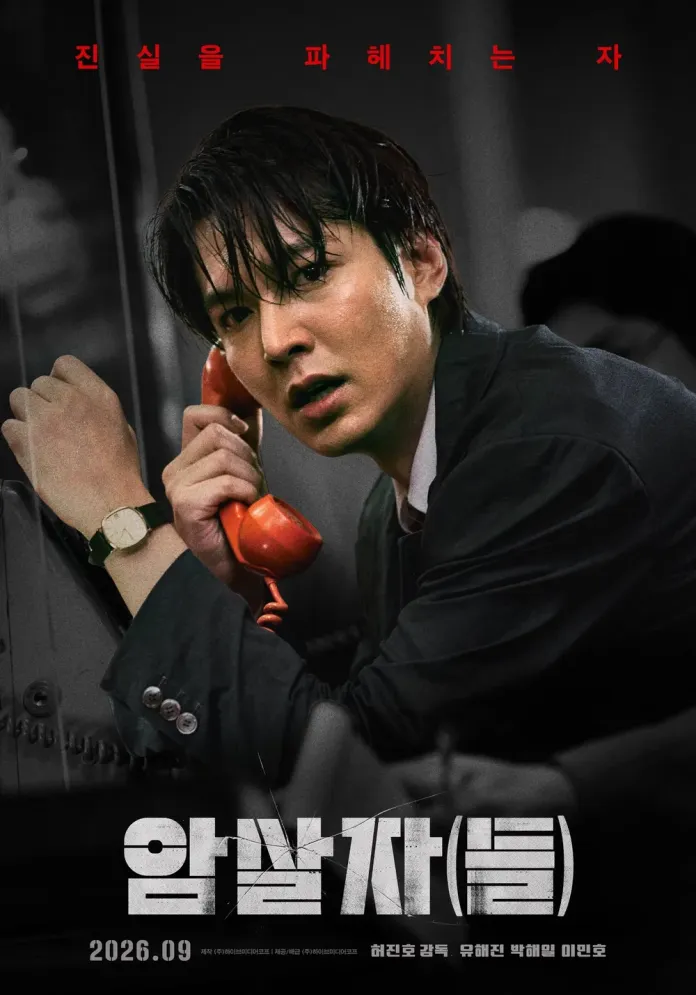
A Different Kind of Role for Lee Min-ho
Lee Min-ho has spent much of his career playing highly controlled and visually polished characters, from wealthy heir Gu Jun-pyo in “Boys Over Flowers” to Koh Hansu in the international series “Pachinko.”
Young-il offers a different energy.
The character can be playful and relaxed even while working inside an increasingly dangerous political situation. His confidence does not come only from courage. It is also connected to the social protection provided by his powerful family background, making him both useful and difficult for the people around him to control.
Lee said he approached Young-il as someone who could move more freely because of that privilege. Instead of hiding the character’s advantages, the performance uses them to explain why Young-il is able to challenge authority in ways that others cannot.
The role also places Lee alongside two actors known for grounded, detail-oriented performances. Rather than competing with Yoo Hae-jin and Park Hae-il through greater intensity, Lee contributes a younger and more spontaneous rhythm to the ensemble.
‘Assassin(s)’ Passes One Million Admissions in Four Days
The film crossed the one-million-admission mark on September 26, its fourth day in theaters. Distributor Hive Media Corp confirmed that its cumulative audience had already surpassed 1.05 million that morning.
“Assassin(s)” also remained at the top of the Korean box office during the Chuseok period, drawing more than 1.4 million viewers between September 24 and 27.
Audience responses have highlighted the cast’s performances, fast-moving plot and the tension created by the investigation. Viewers have also praised the film’s production design and cinematography, which reconstruct the political and media environment of 1970s Korea.
Its continued position at the top of the Korean film reservation chart suggests that interest did not disappear immediately after the holiday.
Director Hur Jin-ho Moves Into Political Mystery
“Assassin(s)” was directed by Hur Jin-ho, the filmmaker behind “Christmas in August,” “One Fine Spring Day,” “The Last Princess” and “Forbidden Dream.”
Hur is widely associated with carefully observed emotions and restrained human relationships. In “Assassin(s),” he applies that attention to character and atmosphere within a political mystery structure.
The film does not rely solely on the historical incident itself. Its central tension comes from watching a detective and two journalists attempt to separate evidence from officially accepted narratives in an environment where searching for the truth carries personal consequences.
That theme also explains why Young-il is important to the story. Lee Min-ho’s character represents a generation still willing to move impulsively toward the truth, even when the older figures around him understand exactly how dangerous that decision can become.
Lee Min-ho Strengthens His Position on the Big Screen
The early performance of “Assassin(s)” adds another commercially successful project to Lee Min-ho’s career and demonstrates his ability to work within a large ensemble.
His global popularity may have helped attract international attention, but the role of Young-il depends less on his established romantic-star image and more on timing, chemistry and character detail.
The film’s box office rise therefore matters for more than its admission total. It presents Lee Min-ho in a different acting position: not as the untouchable center of a fictional world, but as one part of a tightly constructed investigation driven by competing personalities.
With “Assassin(s)” remaining the most reserved Korean film after its opening-week success, attention is now focused on whether positive word of mouth can carry the thriller through the upcoming National Foundation Day holiday.
“Assassin(s)” is currently screening in theaters across South Korea.
- HOT NEWS
- ILLIT, Realistic portrayal of anger... New album concept film released
- Dragonpass: AI Is Shifting the Membership Economy from Perks Redemption to Personalized Experiences
- YENA Brings Humor and Empathy to the Emotional “My Remaining Love” Finale
- "Lumina 919" Illuminates a New Chapter in Philanthropy
- Taemin postpones North American tour with two weeks left until performance: "Key staff members were not issued visas"



허블 정보
Copyright © 2017 Huvle All Rights Reserved
admin@huvle.com