
[Kang Il-hong's Close-up] "It's all my responsibility" IU... Is 'Star Shield' really justified?
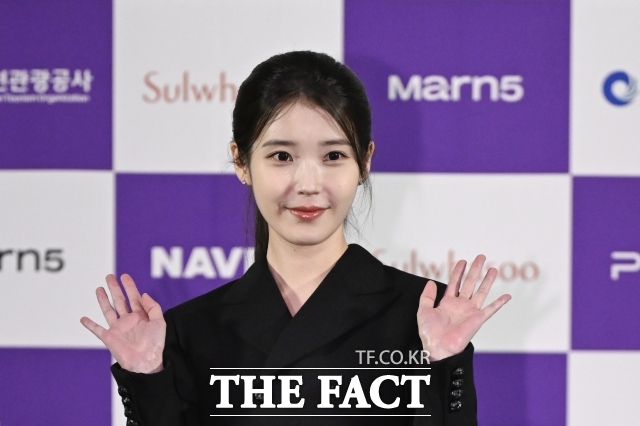 What is the scope of responsibility a star should bear... Agency explains on behalf of fans' complaintsFrom abuse of power and contracts to settlements and safety issues... Asking about the 'responsibility system' in the entertainment industryIU stated on a fan communication platform, "If you felt regret and shortcomings in the promotion, it's all my responsibility," in response to fans' complaints and criticisms that "the promotion for the recently released single was not sufficient." / Reporter Song Ho-young[THE FACT|Reporter Kang Il-hong] It is no longer unusual to see stars directly stepping in to diffuse fan complaints directed at their agencies in the entertainment industry. However, this time it was a little different. Singer IU directly explained the fans' dissatisfaction with the recent new song promotion, hair, makeup, and styling, actively shielding the agency and staff.IU stated on a fan communication platform, "If you felt regret and shortcomings in the promotion, it's all my responsibility," in response to fans' complaints and criticisms that "the promotion for the recently released single was not sufficient." The singer explained that this single was released suddenly without prior notice, and it was their own suggestion to save on promotion this time to focus on the full album next year.The singer also actively explained the controversy surrounding the styling. They stated that it was not a matter of the capabilities of a specific shop or staff, but rather a limitation in products that could be used due to their physical condition. They also explained that the staff accompanying them to the hospital, studying ingredients, and personally testing them to manage their condition, adding, "It may seem like I'm just covering for those around me, but it's all true."The popular culture and arts industry does not run solely on the talent of stars. The agency's system, which manages contracts, coordinates schedules, handles settlements, oversees on-site safety and human rights, and responds to problems when they arise, must work in conjunction. The photo shows IU posing at the production presentation of MBC's new Friday-Saturday drama 'The Great Lady of the 21st Century' in April. / Reporter Kim Sung-ryeol◆ Entertainers are products, and it is the agency's basic duty to manage them in the best possible way.Typically, entertainers are compared to products, and it is the agency's or company's basic duty to manage those products in the best possible way. Of course, in the case of IU, the agency's fault has not been confirmed. Rather, the singer decided on the promotion direction, and the staff were doing their best for them. For a top star like IU, the company manages the star, and at the same time, the star participates in the company's important decision-making. In that case, responsibility cannot be one-sided.Ultimately, what is important is not who takes responsibility, but whether the structure of responsibility operates transparently. According to data submitted to the National Assembly's Culture, Sports and Tourism Committee by Rep. Jin Sun-mi from the Ministry of Culture, Sports and Tourism, 2,911 out of 19,998 businesses subject to legal education for popular culture and arts planning businesses from 2021 to 2025, or 14.6%, did not complete the education. However, there were no fines imposed by the Ministry of Culture, Sports and Tourism for failure to complete the legal education during this period.Legal education is not just a formal exercise. According to relevant laws, planning business operators must receive education annually, and the content of the education includes the protection of the rights and interests of popular culture and arts performers, fair business order, and contract-related matters. The popular culture and arts industry does not run solely on the talent of stars. The agency's system, which manages contracts, coordinates schedules, handles settlements, oversees on-site safety and human rights, and responds to problems when they arise, must work in conjunction.◆ Whenever problems arise in the entertainment industry, the public too easily focuses on 'individual misconduct by stars.'However, whenever problems arise in the entertainment industry, we too easily focus on 'individual misconduct by stars.' When abuse of power controversies arise, we first ask, 'Why did that entertainer do that?' and when contract disputes occur, we ask, 'Who was greedy?' When settlement issues arise, one party, either the star or the company, is immediately designated as the perpetrator or victim. Even when safety accidents occur, they are often concluded as personal mistakes on-site.However, if entertainers are described as 'products,' the story changes. If it is the agency's job to increase and continuously manage the value of a product, then protecting that product is also an important responsibility of the agency. Especially in industries where people are treated like products, the system for protecting their rights and safety must be more sophisticated.The current Popular Culture and Arts Industry Development Act also defines popular culture and arts planning business not as simple management work, but as a business that provides and brokers services for popular culture and arts performers, and provides training, guidance, and counseling. It also stipulates that contracts must specify rights and obligations, profit distribution, dispute resolution, and child and adolescent protection. In other words, the law views the planning company not merely as a company that schedules events, but as a business operator that manages the rights and obligations surrounding the entertainer's activities.◆ "It should be the organizational responsibility system that operates first, not the individual self-sacrifice of the star."There is no need to stop at the level of saying that IU's recent remarks were "covering for the agency" or "accepting the fans' criticisms." Instead, we need to look at this scene where a star has to explain on behalf of the company and staff under their own name. A star becoming a shield for the company can sometimes be beautiful camaraderie. IU's actions can also be seen in that context. However, if the structure is such that all problems are resolved through the star's responsibility and sacrifice, the story changes.Entertainers are not made alone. Behind the stars are numerous planning, production, and management personnel, and behind that organization are laws and systems. Therefore, when problems arise, the first priority that should operate should be the organizational responsibility system, not individual self-sacrifice. IU said, "If it was insufficient, it's my responsibility." This is a sincere explanation from a top star and can be very appreciated by fans.However, it is problematic for the entire entertainment industry to be too accustomed to this one phrase. If a star makes a mistake, the star is responsible, and if the company makes a mistake, the company is responsible. Perhaps what the entertainment industry needs now is not a system that manages stars more meticulously, but a system that properly manages the people and companies that manage stars. The real question left by IU's phrase, "It's all my responsibility," lies here.eel@tf.co.kr
- HOT NEWS
- 'Heart Made with Tom Cruise' [Photo]
- Stray Kids ignite Mexico City with a passionate stage... "Sincere communication with fans"
- Director Yoo In-sik of 'The 100-Day Lie' "Of course, historical accuracy was a burden... I did my best."
- Hong Ji Yoon shares recent updates with fans at Yeosu Night Sea... "A smile full of love"
- (G)I-DLE's SOYEON achieves first solo 'Perfect All-Kill' with 'I'll Quit'.


허블 정보
Copyright © 2017 Huvle All Rights Reserved
admin@huvle.com