[K-Pop Next Level 2] Can 'K-Pop Concept' Be a Music Genre?
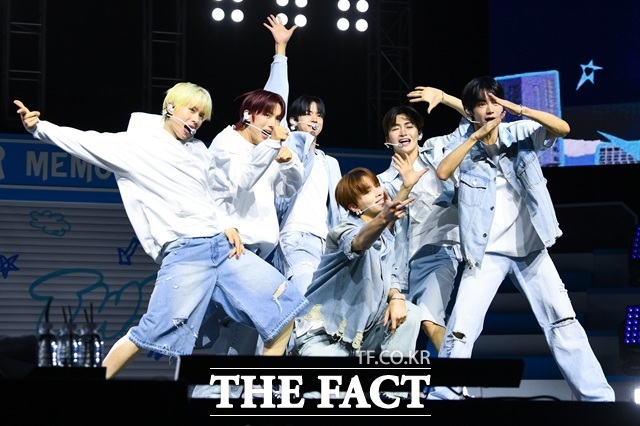
Attempts to subdivide 'K-pop concepts' into subgenres are increasingConcepts like 'refreshing' and 'girl crush' have the potential to become genres in themselvesThe group TWS achieved great success by fronting the 'refreshing' concept. There are now attempts to categorize concepts like this 'refreshing' one as subgenres of K-pop. / THE FACT DB'K-pop' is showing signs of evolving beyond 'music made in Korea' into a 'major genre of popular music.' This is not a matter of patriotism or self-awareness, but a reality unfolding in the global popular music market. Indeed, in countries that hold significant weight in the global music market, such as the United States and Japan, as well as Southeast Asia, an increasing number of groups are debuting with 'K-pop' as their primary genre.
examined the possibility of K-pop establishing itself as a full-fledged 'major genre of popular music,' akin to rock or hip-hop, through case studies of these groups. It also predicted the future competition with 'K-less K-pop' that will occur in the global music market. [THE FACT|Reporter Choi Hyun-jung] The reason for considering K-pop's potential as a music genre is related to the 'universality of music.'The term K-pop itself includes the regional name Korea, and for this reason, K-pop has long been perceived as 'songs made in Korea and sung by Korean artists.' However, as K-pop gains global popularity, K-pop that transcends Korea is now emerging. (Related article [K-pop Next Level 1] Is K-pop a 'Major Music Genre'?)Moreover, in the popular music scene, it is common for music originating from a specific region or group to become widely popular and establish itself as a universal genre. A prime example is 'Afrobeats,' which originated in West African regions like Nigeria and Ghana, and has now become a globally popular genre. Similarly, hip-hop, which was born primarily among Black Americans, can be found anywhere in the world, regardless of race or nationality.Therefore, if the characteristics and criteria that distinguish K-pop from other music are established, it will be easier for anyone to accept K-pop as a music genre, regardless of nationality or production entity. This is why it is necessary to examine the genre identity of K-pop.However, unfortunately, experts generally agree that K-pop, having evolved from its early stages by combining various genres to create new sounds, is music that is difficult to establish unique characteristics or criteria as a single genre.Of course, K-pop does have unique characteristics, such as part distribution that inevitably arises from the format of large groups, song structures centered on performance, and developmental methods for dance breaks or vocal climaxes. However, these are merely devices that create a 'K-pop-like vibe' and are considered insufficient to establish it as a genre.Interestingly, while the musical characteristics that comprehensively define K-pop itself are ambiguous, specific concepts frequently used in K-pop often possess relatively clear musical characteristics.For instance, the 'refreshing concept' often utilizes major key harmonies with a bright feel, upbeat rhythms, clear and crisp instrument tones, and an ascending song progression. 'Girl crush' also shows consistent musical tendencies, such as minor key-centric harmonies, strong riffs, heavy bass and beats, dramatic contrasts between rap and vocals, and tough rapping or chanting.'Girl crush' is also a representative K-pop concept that is undergoing genre development. The photo shows the group aespa performing their stage for 'Armageddon.' / THE FACT DBFor this reason, in overseas K-pop communities, there is a movement to treat and distinguish K-pop concepts like 'refreshing' or 'girl crush' as genres in themselves. In fact, Steinberg, the company that develops the music production software Cubase, offers a course titled 'How To Create Groove And Bass For Girl Crush.'In this course, K-pop composer Azodi presents the characteristics of 'girl crush' and the formula for creating it, including elements of trap and house, 808 snares, trap claps, basslines, the use of individual members' vocals and rap, as well as tempos from 80 to 125 BPM. This implies that from a composer's perspective, 'girl crush' has clear musical characteristics that can be inferred from the term itself.Furthermore, K-pop's subcategories are being classified by concept in overseas K-pop communities. Currently, when introducing stages on music shows or concerts, most people can anticipate the type of music and performance that will be presented when terms like 'refreshing,' 'sexy,' 'innocent,' or 'girl crush' are used.This phenomenon indicates that K-pop concepts are being recognized not merely as tools for styling, fashion, or performance, but as styles that share musical characteristics. If such styles gain support, they have the potential to develop into independent music genres.Im Hee-yoon, a popular music critic, stated, "In fact, not only K-pop but also the existing genre distinctions in the popular music scene are becoming obsolete. Younger generations tend to approach music based on atmosphere or vibe rather than genre. If you look at Melon or Spotify, music is recommended through playlists like 'Music for Your Mood' rather than by genre. This phenomenon, where listeners' approach to music, the platform's categorization of music by keywords, and the tendency to enjoy music visually as well as audibly, are all interacting, seems to be causing this trend (of accepting 'refreshing' as a genre)."However, opinions are divided between producers and critics regarding the 'gengrification of K-pop concepts.' Woo Young-seung, general producer at Nuance Entertainment, commented, "Taking 'refreshing' as an example, I have never considered it an independent music genre of K-pop. 'Refreshing' is closer to a concept that encompasses music, performance, visuals, and the artist's image. Of course, if a specific concept is repeatedly used, it may be recognized as a unique style by people, but I believe that developing it into a music genre is a different matter."Steinberg, the developer of the music production software Cubase, has released a lecture with K-pop producer Azodi on creating 'girl crush' grooves and bass. This demonstrates that K-pop concepts have distinct musical characteristics. / Screenshot from Cubase's official YouTube channelPark Sung-ho, a K-pop producer and former member of the group Cool, also said, "I think it should be viewed more as a performance. I believe it's a promotional tactic where various concepts are projected onto the music."On the other hand, Yoon Dong-hwan, a member of the Cultural Arts Policy Advisory Committee directly under the Minister of Culture, Sports and Tourism, stated, "Concepts can also become genres. For producers, it's common to decide on a concept after the music is released, so they tend to view them separately. However, if the songwriting methods are established and the style is maintained, and people accept it as music in itself, then it becomes a genre. It is entirely possible for a concept to become a genre."Cho Hye-rim, a popular music critic, also said, "For example, city pop is a genre that represents an urban atmosphere. In this way, I believe 'refreshing' can also be a genre. 'Refreshing' already has consistent sounds like bright tempo, guitar, and synth, as well as luminous word expressions and emotions like summer days and youth. Therefore, it is not strange to consider it a subgenre of K-pop."Furthermore, critic Cho Hye-rim stated that this genre development of concepts is a phenomenon that well illustrates the characteristics of K-pop. Cho Hye-rim added, "While musical style diversification is clearly occurring within K-pop, it is difficult to equate it with the formation process of subgenres like rock or hip-hop. The segmentation of K-pop involves a complex interplay of not only musical characteristics but also concepts, performances, visuals, and fandom preferences. Therefore, 'refreshing,' 'girl crush,' 'easy listening,' and 'metal taste' serve as subgenres."As such, attempts to clearly define K-pop and genre-fy concepts may not bring about significant immediate changes in the music market. However, from a long-term perspective, this can help K-pop secure 'universality as popular music,' thereby gaining stronger vitality and exerting greater influence.For example, if 'refreshing' or 'girl crush' become globally recognized genres, they will invariably be placed at the forefront, regardless of where the music is produced.Moreover, K-pop is likely to face competition in the global market from 'diverse K-pop independently produced in various countries.' The definition of K-pop and the attempts at genre development also empower Korea to maintain its leadership in such competition. predicted the flow of competition with 'K-less K-pop' with related experts. [K-pop Next Level 1] Is K-pop a 'Major Music Genre'?[K-pop Next Level 3] The Future Brought by 'K-less K-pop'[K-pop Next Level 4] Is Japan an Ally or Enemy of K-pop?laugardagr@tf.co.kr[Entertainment Department | ssent@tf.co.kr]