
A Web Novel Modeled a Fictional Idol Group on SEVENTEEN’s Name Then Gave Them Scandals and Member Exits.
“13 members + 3 units + 1 team” is sacred math to SEVENTEEN fans. When a Kakao Page web novel borrowed the arithmetic for a story about a group falling apart, the backlash was swift enough to force a same-weekend rewrite.
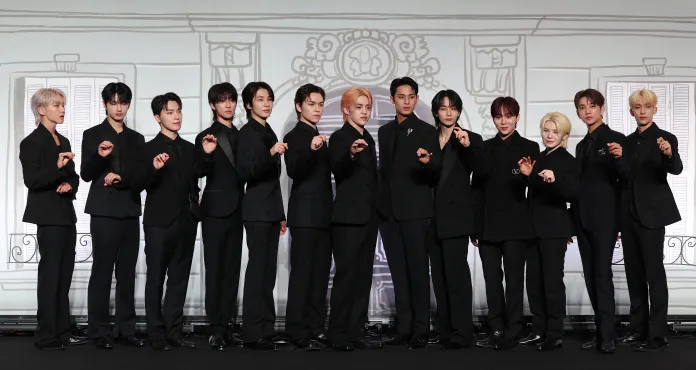
Some numbers carry more weight than others. For SEVENTEEN, “17” has never just been a name it’s a formula: 13 members, 3 sub-units, 1 team, equaling the group’s full identity. It’s also a point of genuine pride for the Korean boy band, which has operated for nearly a decade without losing a single member to departure, a rarity in an industry defined by attrition. So when a newly serialized web novel built its premise around a fictional idol group whose numbered name stopped matching its member count for reasons involving contract terminations, scandal, and an uncomfortable joke about “three deaths” the resemblance didn’t go unnoticed. Within a day, both the author and the publisher were posting apologies, and by the weekend, the manuscript itself was being rewritten.

How a Webtoon Platform Debut Turned Into a PR Crisis
The novel in question, Ideal Idol’s Regression Memoir by author Cheongdo Bokshunga, began pre-serialization on Kakao Page on October 23. Its first chapter introduced “Eleven,” a fictional eleven-member multinational idol group under a major entertainment agency. As the plot unfolds, members leave the group one by one through contract terminations and various incidents until the group is whittled down to seven. The novel attempted to explain the mismatch between the group’s numeric name and its shrinking member count through a formula combining members, teams, and fandom and included a line in which fans, asked about the discrepancy, respond that “three died.”
Korean readers connected the dots immediately. SEVENTEEN’s own name is built on the same kind of numeric formula 13 members, 3 units, and 1 team adding up to 17 and the band has long emphasized its unbroken lineup as part of its identity. Critics argued that borrowing that specific branding logic for a story centered on scandal, member departures, and a particularly dark joke about member deaths crossed a clear line, especially for a group that has never actually experienced an exit.
The Apology Trail
The response moved fast by publishing-industry standards. Author Cheongdo Bokshunga posted an apology on social media on October 23, initially saying revisions would arrive the following Monday then accelerated the timeline after communicating with the publisher, committing to weekend edits instead. In the apology, the author maintained there was no intent to disparage any specific group, writing that because the real group’s achievements were already so firmly established, it seemed unlikely that the resemblance would cause actual harm a rationale that, notably, didn’t land well with readers already upset by the premise.
Publisher KW Books followed with its own apology on October 24, stating it was taking seriously both the concern that the group name and certain settings and expressions in the work could evoke an existing idol group, and the fact that this resemblance was paired with a narrative centered on negative incidents.
What Actually Changed and What Didn’t
The revisions are real but narrower than some readers wanted. The fictional group’s name was changed from “Eleven” to “Phazer.” The explicit framing of an eleven-member group shrinking to seven, along with the specific language built around the member-count discrepancy, was removed from the revised first chapter.
What remains, however, is the underlying narrative skeleton: members still leave the group, get expelled for wrongdoing, and the group’s reputation still declines as a result. Some third-party synopsis pages for the novel, as of this writing, still describe the original premise of a team that “started with 11 and ended with 7” meaning readers browsing the title through outside platforms may still encounter the pre-edit framing even as the in-app chapter has been revised. KW Books has advised existing purchasers to delete the chapter from their library and redownload it to see the corrected text.
Why This Keeps Happening in Korean Web Fiction
This isn’t an isolated hiccup it’s a recurring friction point in Korea’s web novel and webtoon industry, where “idol-world” romance and drama is one of the most reliable commercial genres, and where authors frequently build fictional groups whose names, member counts, or histories gesture toward real acts without naming them outright. Most of the time, the resemblance is loose enough to read as homage or inside-joke world-building. The trouble starts when a story’s fictional analog is paired with negative material scandal, misconduct, exits because the implied real-world target then absorbs reputational risk it never agreed to.
For SEVENTEEN specifically, the sensitivity is compounded by the band’s own narrative about itself. Member stability has become something the group and its fandom, Carat, treat as a point of distinction in an industry where lineup changes are common enough to barely register as news elsewhere. A story that borrows the group’s defining numerical identity and then subjects it to the exact instability SEVENTEEN has avoided wasn’t likely to read as neutral to anyone paying attention.
The Takeaway
The speed of this apology-and-revision cycle identified on the 23rd, two public apologies by the 24th, manuscript changes delivered within the same weekend suggests Korean publishers are increasingly aware that idol-adjacent fiction operates under real scrutiny, not just from casual readers but from highly organized, highly attentive fan communities who notice numerical details most outside observers would miss entirely. Whether the current revision fully resolves the concern is still an open question, given that the core plot of a group’s unraveling remains intact. What’s clear is that in 2026’s K-content landscape, fictional idol groups don’t exist in a vacuum and neither do the numbers in their names.
- HOT NEWS
- CORTIS, fans focus on the natural smile revealed in daily life
- Cohesity Announces FY2026 Partner Award Winners
- Dance dramas bridge cultures across Southeast Asia
- SHINee Onew, WOODZ, LEEDS, NCT WISH, decorate the music talk stage of 'Sung Si-Kyung's Eardrum Boyfriend'
- Kim Ji-won’s ‘Doctor X’ Holds No.1 Worldwide for a Second Straight Week


허블 정보
Copyright © 2017 Huvle All Rights Reserved
admin@huvle.com