
The K-Drama Where Actors Spent a Year Mastering 3 Languages for One Role
Some actors learn a few lines of a foreign language for a role. The cast of 100 Days of Deception learned to think in three.
As tvN’s Saturday-Sunday period drama 100 Days of Lies climbs the ratings charts, the production has pulled back the curtain on just how far its cast went to make a story about interpreters and deception feel authentic and the answer involves five-month immersion courses, two months living in Japan, and at least one actor who admitted a language coach’s recorded voice followed him into his dreams.
A Drama Built on the Danger of Words
Set during Korea’s Japanese colonial period, 100 Days of Deception centers on interpretation itself the high-stakes, split-second art of moving between Japanese, English, and Korean when a mistranslation could cost someone their life. It’s a premise that only works if the language on screen feels real, not performed. Director Yoo In-sik acknowledged as much, revealing that the cast began foreign-language training the moment they were cast, with some actors training for over a year through to the final day of filming.
To pull that off, the production brought in dedicated Japanese, English, and Chinese coaches who worked one-on-one with actors and stayed on set for every foreign-language scene, checking pronunciation line by line. It’s an unusually intensive setup for Korean television, where dialogue coaching rarely extends to full-time, on-set language supervision for an entire ensemble cast.

Kim You-jung’s Five-Month Transformation
For Kim You-jung, who plays Lee Ga-kyung, preparation began five months before cameras rolled. Rather than simply memorizing phonetic scripts a common shortcut in productions under time pressure she enrolled in three concurrent tracks: grammar, conversation, and script comprehension.
The choice reflects character logic as much as craft. For Lee Ga-kyung, Japanese and English are survival tools, languages absorbed informally rather than through formal schooling. Kim reportedly built in a subtle performance detail to sell this: the cadence of someone stitching together memorized vocabulary on the fly, rather than speaking with native fluency. Her Japanese coaching team praised her ability to internalize intonation patterns so completely that she began self-correcting her own mistakes a level of ear-training that, they noted, made it hard to even estimate how many hours she’d put in.
It’s the kind of detail that rewards rewatching, and it’s a strong signal of why Kim, already known for range across projects, continues to be cast in roles that demand more than surface-level transformation.

Park Jin-young’s Voice-in-His-Head Commitment
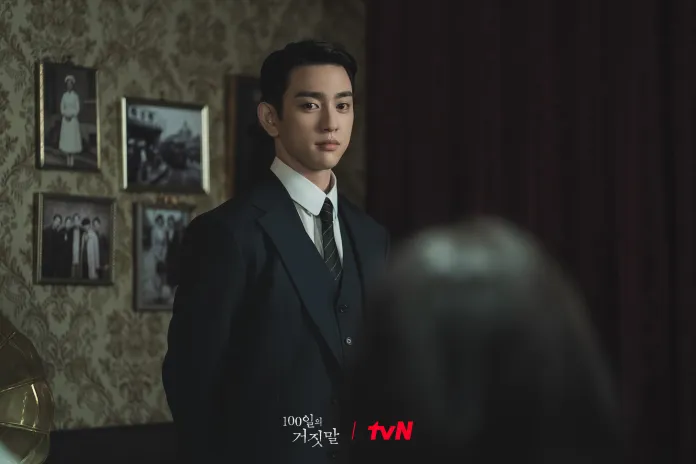
Park Jin-young, playing elite interpreter Sato Hideo (also known as Kim Tae-woong), started his preparation in February and drilled nothing but his Japanese script lines through the entire shoot. His coaching team’s anecdote has already become the story’s most-quoted detail: after listening to recordings of his coaches on repeat to nail the character’s accent, Park reportedly told them the voices kept echoing in his ears even as he tried to fall asleep. Juggling back-to-back Japanese and English lessons on top of his existing workload, the team noted, he never stopped treating the process as something to enjoy rather than endure.
Kim Hyun-joo’s Chinese Debut and the Reverse-Engineering Trick
Playing Yoo So-ran, Kim Hyun-joo took on the only Chinese-language role in the cast a first for the actress. Her approach added an unusual wrinkle: rather than only studying Chinese pronunciation, she closely observed how her Chinese-language coach spoke Korean, reverse-engineering the accent patterns in both directions. Her coach praised her refusal to let even minor pronunciation slips go unaddressed, continually refining her delivery until it felt unforced.
The Subtlety Beneath the Subtitles: Accented Japanese, Done Three Different Ways
What elevates this from “actors studied hard” to genuinely distinctive directing is how deliberately the production differentiated accents within the same language. Lee Moo-saeng, who plays Yoo Philip, wasn’t coached to speak textbook Japanese his team instead curated reference videos showing how English-speaking foreigners inflect Japanese, aiming for the specific texture of a non-native speaker filtered through an Anglophone accent. Lee leaned into the idea that an American speaking Korean or Japanese would sound subtly different from anyone else on the show, and supplemented his prep by studying 1930s-era films for period-appropriate speech patterns and gestures.
Then there’s Jin Seon-kyu, whose transformation may be the most striking of the ensemble. Reportedly starting with zero Japanese ability, he spent two months living in Japan, memorizing script pages seven hours a day. His coaches admitted they’d worried he might pick up a regional Kyoto accent during his stay, so they arranged for a Japan-based actor to supervise his lines in person. His routine: Japanese conversation each morning, script drilling each afternoon, and twice-weekly video calls back to his Seoul-based coaching team on top of mastering a Japanese character’s accented Korean dialogue, which the team said was substantial enough to be “almost painful to watch him take on.” The result, they said, left them with nothing to say except that it was remarkable and reportedly drew praise from audiences in Japan itself, a notable feat for a Korean actor voicing colonial-era Japanese on screen.
Why This Matters Beyond the Set
Language coaching is rarely the headline of a K-drama rollout, but 100 Days of Deception is making a case for why it should be. Colonial-era dramas live or die on believability, and Korean television has a long, sometimes uneasy history of depicting Japanese occupation any misstep in tone or authenticity tends to draw swift public scrutiny. By investing this heavily in linguistic precision across three languages and multiple accent registers, the production is signaling that it understands the stakes of the material it’s handling, not just technically but culturally.
It also reframes what “committed performance” looks like in the K-drama landscape, where physical transformations and emotional range typically dominate awards conversations. Here, invisible labor the thousands of hours spent getting an accent exactly right becomes the thing fans and critics are now talking about before the show has even finished its run.
All twelve episodes of foreign-language dialogue were reportedly locked in before filming began on each actor’s parts, with few flubbed lines on set a detail the coaching team framed simply: the teachers can only do so much. The results come down to what the actors themselves were willing to put in.
Episode 7 of 100 Days of Deception airs October 31 at 9:10 PM KST.
- HOT NEWS
- UNCHILD, November 5th 'Ting Ting' comeback... Revealing the 'Unique Hero' concept
- ILLIT, 380,000 copies on the first day of comeback... 'Kuhaha' is visible
- Master Concept Earns 2026 Cloudflare Growth Partner of the Year Award
- NCT 127 shares their thoughts ahead of their Saitama concert in Japan: "We're so excited to perform on stage after such a long time."
- Ascletis' Strategic Partner Sagimet Announces First Patient Dosed in Phase III U.S. Clinical Trial of Denifanstat (ASC40) for Moderate to Severe Acne



허블 정보
Copyright © 2017 Huvle All Rights Reserved
admin@huvle.com