
SEVENTEEN’s Dino Covers Esquire Japan With Piaget, Reflects on His Solo Journey
The “Art of Color” feature pairs a polished fashion story with Dino’s thoughts on realizing a longtime stage ambition and keeping his work recognizably his own.
For SEVENTEEN’s Dino, the challenge is making something that feels familiar without repeating himself. Appearing on Esquire Japan’s digital cover in collaboration with Swiss watch and jewelry maison Piaget, the performer reflected on how he balances a recognizable artistic identity with the desire to keep surprising his audience.
The feature, themed “Art of Color,” presents Dino through refined styling and restrained charisma. Alongside the photographs, his interview turns toward a more personal milestone: staging the solo performances he had imagined since his trainee years.
The shoot took place in September, after his Seoul “2026 DINOxPICHEOLIN [吉BOARD SHOW]” concerts. Looking back on that experience, Dino described feeling overwhelmed as a scene he had pictured for years finally unfolded in front of him.
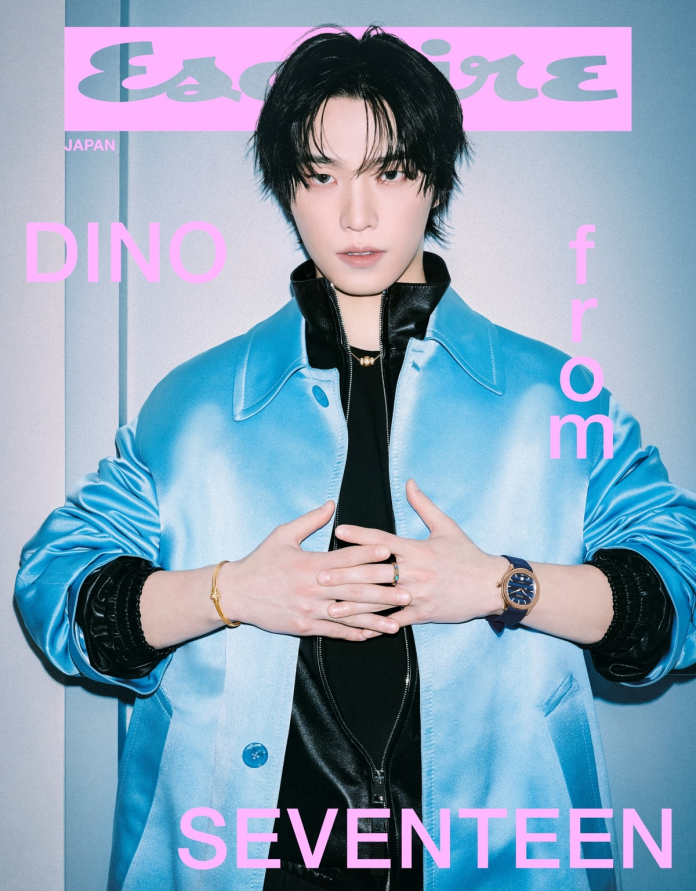
Dino’s Creative Challenge: Familiar, but New
“It’s important to be familiar yet new,” Dino said, explaining that he considers how to express his own color while showing audiences something they have not seen before. He described that balance as a continuing challenge throughout his career as a singer.
The thought connects the fashion feature with the performance work surrounding it. His own identity remains the starting point, while each project becomes an opportunity to find a different expression of it, whether through music, choreography or the character he brings to the stage.
The Piaget collaboration offers another setting for that approach. The “Art of Color” photographs emphasize a composed presence, while the accompanying interview reveals the questions he continues to ask about his work and the expectations he sets for himself.
A Trainee-Era Dream Becomes a Solo Show
Dino’s reflections follow a concert project that brought together two sides of his performance identity: himself and Picheolin, his alter ego. “DINOxPICHEOLIN [吉BOARD SHOW]” gave him space to move between those personalities while carrying a full show as a solo performer.
The repertoire also reached beyond his individual material. He performed SEVENTEEN group songs and tracks associated with its performance-team unit, taking music usually shared among several members into a different stage arrangement.
That scope helps explain the emotion behind his recollection of the Seoul concerts. The milestone involved realizing a long-held ambition while finding ways to connect his group repertoire, solo work and character-driven performances within one show.

Macau Expanded From One Performance to Three
The concert project continued in Macau, where demand led to an expanded schedule. PLEDIS Entertainment’s official announcement confirmed two additional performances on October 9 and 11 around the original October 10 date at Studio City Event Center.
All three performances subsequently sold out, according to Korean coverage citing the agency. The expanded run extended a project that had already allowed Dino to explore different forms of expression through both his familiar stage persona and Picheolin.
His first Picheolin mini-album, “吉BOARD,” formed another part of that work. Its songs include “놀아보세,” produced by Hitchhiker, and the prerelease track “아프지 않은 이별은 없다,” featuring narration by Lee Moon-sae, bringing different collaborators into the character’s musical world.
For Dino, the Esquire interview’s central question remains relevant across those projects: how to retain the qualities audiences recognize while giving them a reason to look again.
Editor’s Note: SEVENTEEN’s official Japanese website identifies this as Dino’s first Esquire Japan digital cover and his first feature inside the magazine. The December 2026 issue goes on sale October 30. The digital cover is distinct from the print issue’s cover; the announcement confirms both a digital-cover appearance and an interior magazine feature.
- HOT NEWS
- NCT Dream to release their 6th full-length album for their 10th debut anniversary... comeback on November 9
- Xinhua Silk Road: 2026 Global Ocean Development Forum held in Qingdao, E China
- A Gunshot, a Breakdown, and a 3-Point Ratings Surge: Kim Yoo-jung’s ‘100 Days of Deception’
- RESCENE PICK Curve Padding · Miyaong Beanie Giveaway, MLB Miya-Hohan Event Starts on the 25th
- CORTIS, 'FANNSTAR' New Star Tops Charts for 14 Consecutive Weeks... Global Success in Digital and Physical Music Draws Attention

허블 정보
Copyright © 2017 Huvle All Rights Reserved
admin@huvle.com