
K-Drama Industry Faces 'Red Flag' as 12 Organizations Urge Government Support (Comprehensive)
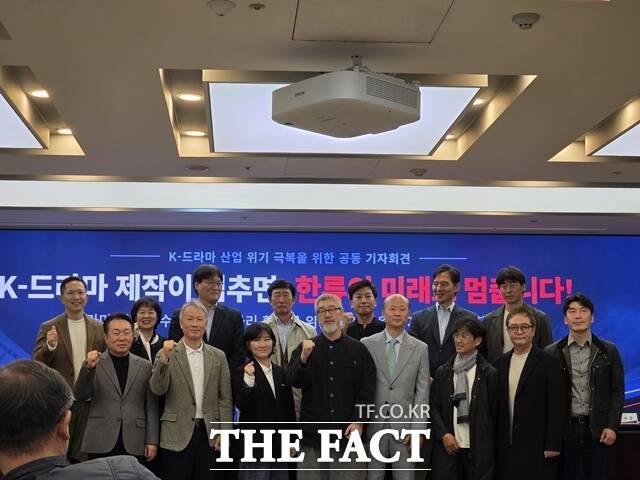 Press conference held to overcome the crisis in the K-drama industry at 11 AM on the 4th"Now is not the time to celebrate past successes... We must prepare for the next 10 years."The Korea Drama PD Association, Korea Broadcasting Performers Rights Association, Korea Broadcasting Actors Union, Korea Broadcasting Actors Association, Korea Broadcasting Writers Association, Korea Broadcasting Channel Promotion Association, Korea Broadcasting Cinematographers Association, Korea Broadcasting Association, Korea Cable TV Broadcasting Association PP Council, Korea PD Federation, and Hope Solidarity Union Broadcasting Staff Branch held a press conference to overcome the crisis in the K-drama industry at the press conference room on the 19th floor of the Korea Press Center in Jung-gu, Seoul, at 11 AM on the 4th, urging the government and the National Assembly to respond with policy. /Reporter Choi Soo-bin[THE FACT|Reporter Choi Soo-bin] The production environment of K-dramas is shaking. Amid growing crisis across the industry due to a decrease in the number of productions and a contraction in investment, 12 organizations from the broadcasting and drama sectors have spoken with one voice. They urged the government and the National Assembly to actively support the sustainable growth of K-dramas.A press conference to overcome the crisis in the K-drama industry was held at the press conference room on the 19th floor of the Korea Press Center in Jung-gu, Seoul, at 11 AM on the 4th. Kim Jong-chang, President of the Korea Drama PD Association, Song Young-woong, Chairman of the Korea Broadcasting Performers Rights Association, Song Byung-joon, Chairman of the Korea Drama Production Association, Kim Hee-yeol, Vice Chairman of the Korea Drama Production Association, Park Hae-young, Writer (Chairman of the Copyright Committee of the Korea Broadcasting Writers Association), and Kim Tae-bong, President of the Korea Broadcasting Cinematographers Association, attended and emphasized the need for policy responses to restore the drama production base to the government and the National Assembly.The press conference, hosted by the Korea Drama Production Association, was attended by a total of 12 organizations, including the Korea Drama PD Association, Korea Broadcasting Performers Rights Association, Korea Broadcasting Actors Union, Korea Broadcasting Actors Association, Korea Broadcasting Writers Association, Korea Broadcasting Channel Promotion Association, Korea Broadcasting Cinematographers Association, Korea Broadcasting Association, Korea Cable TV Broadcasting Association PP Council, Korea PD Federation, and Hope Solidarity Union Broadcasting Staff Branch.They pointed out the current state of the K-drama industry, which is suffering from a sharp decline in the number of productions and a contraction in investment, and unanimously stated that national-level support is urgently needed. In particular, they said that effective policy responses are necessary as the entire industry, from production companies to writers, actors, and staff, is facing a crisis.Song Byung-joon, President of the Korea Drama Production Association, who led the press conference, said, "Our K-dramas have become content loved by the world. However, the production environment that created those achievements is shaking," adding, "It is very difficult to restore a collapsed production site. Now is not the time to look back at past successes, but to look ahead to the next 10 years of K-dramas."Writer Park Hae-young said, "The Korean drama market has undergone significant changes with the entry of global OTT. While we have gained global recognition, the production costs of global OTT have skyrocketed, making it impossible for domestic production companies and broadcasters to create dramas solely with their own capital."Song Byung-joon, President of the Korea Drama Production Association, argued, "We must look ahead to the next 10 years of K-dramas." /Reporter Choi Soo-binHe added, "In any country, the strongest storytellers go to places where the industry is good. If storytellers were strong because the drama industry was good until now, they are now starting to move to other genres because the atmosphere is not the same," and "My dream is to keep watching interesting dramas. I hope that before it's too late, this vicious cycle will be broken and measures will be established for our Korean dramas to have self-sustainability."According to data compiled by the Korea Drama Production Association, the number of domestic drama productions decreased by about 30% in two years, from 141 in 2022. The organizations analyzed that this was a result of a combination of factors, including rising production costs, reduced investment and programming capacity of broadcasters, and difficulties for production companies in securing intellectual property and subsequent profits.The organizations warned, "The sharp decrease in the number of productions is a warning sign that leads to the collapse of the industry. If production decreases, jobs and creative opportunities disappear, and the departure of skilled personnel and production organizations leads to a vicious cycle that further degrades the production capabilities of the entire industry."Broadcasters have also significantly reduced drama programming. The number of drama productions by the three major terrestrial broadcasters decreased from 91 in 2012 to 32 in 2023, and some channels have even stopped broadcasting weekday dramas. The explanation is that broadcasters are also forced to reduce drama production as it becomes difficult to recoup production costs solely through advertising revenue.The decrease in the number of productions also leads to a reduction in jobs and creative opportunities. The organizations expressed concern, "When a production is canceled, the jobs and careers of numerous people who would have participated in that work also come to a halt," adding, "Those who lead K-dramas today also grew up through that path. If this path is cut off, it will be difficult for the next generation to even enter the field."Considering the impact of K-dramas on the spread of Hallyu and the national economy, government support is even more crucial. According to the Ministry of Culture, Sports and Tourism and the Korea Foundation for International Cultural Exchange, the total export value related to Hallyu in 2025 is expected to be $18.975 billion (approximately 25.616 trillion won). Of this, consumer goods and tourism exports amount to $8.788 billion (approximately 11.8638 trillion won).The organizations demanded, "We request that the recovery of the annual number of drama productions be set as a national policy goal." /Reporter Choi Soo-binThe organizations emphasized, "This is an achievement made by various Hallyu content together, and dramas have been the core medium leading that trend," adding, "Strengthening the drama production base is not just supporting the content industry, but a national investment that drives exports and tourism and enhances Korea's cultural status and national brand value."However, government support budgets for the broadcasting and video sector have actually decreased. In the government budget proposal for 2027, the budget for the broadcasting and video sector of the Ministry of Culture, Sports and Tourism decreased from 91.8 billion won to 87.3 billion won, a decrease of 4.5 billion won. The budget for the promotion of broadcasting content by the Korea Communications Commission also decreased from 16.8 billion won to 12.4 billion won, a decrease of 4.4 billion won.At the same time, Japan has made the overseas expansion of live-action content, including dramas, a national strategy, setting a goal of over 250 billion yen (approximately 2.25 trillion won) in exports by 2033 and requesting five times the budget for related projects next year compared to this year. The organizations stated, "There is a clear difference between how competing countries respond to crises and how we respond," adding, "If the scale of the crisis has changed, the scale and method of response must also change."In response, the organizations demanded the following: ▲ Setting the recovery of the annual number of drama productions as a national policy goal ▲ Actively considering the establishment of a mid- to long-term K-drama investment and support system worth 1 trillion won ▲ Establishing a foundation for the programming and distribution of invested works in conjunction with domestic broadcasters and OTT platforms ▲ Recognizing the crisis in the drama production industry as a national policy task and implementing comprehensive responses.The organizations emphasized, "Now is not the time to celebrate past successes. It is time to prepare for the next 10 years of K-dramas. If we do not intervene now in the collapsing foundation, the achievements of K-dramas, loved by the world, will not continue for long," adding, "We will also fulfill our responsibilities. We will rationalize the production cost structure and establish fair production practices. We urge the government and the National Assembly to respond."subin7134@tf.co.kr[Entertainment Department | ssent@tf.co.kr]
- HOT NEWS
- Self-Care Momentum Builds Across Asia-Pacific: Regional collaboration drives progress across health literacy, Regulatory streamlining and Leveraging Digital Solutions
- Tencent and Mastercard Sign MOU on Cross-Border Payment Interoperability and Agentic Payments
- Satire, lost 37kg in 1 year and 5 months... Reveals current status with Shingiru
- 'Assassination' Officially Surpasses Break-Even Point... Cumulative Audience of 3.4 Million
- SEVENTEEN’s Dino Drops a Surprise Love Song, “AUTOMATIC” A Sharp Left Turn From His Trot Era



허블 정보
Copyright © 2017 Huvle All Rights Reserved
admin@huvle.com