[The Era of Collaboration 3] 'Diluted Identity' and 'IP Dominance'... Challenges of Global Co-productions
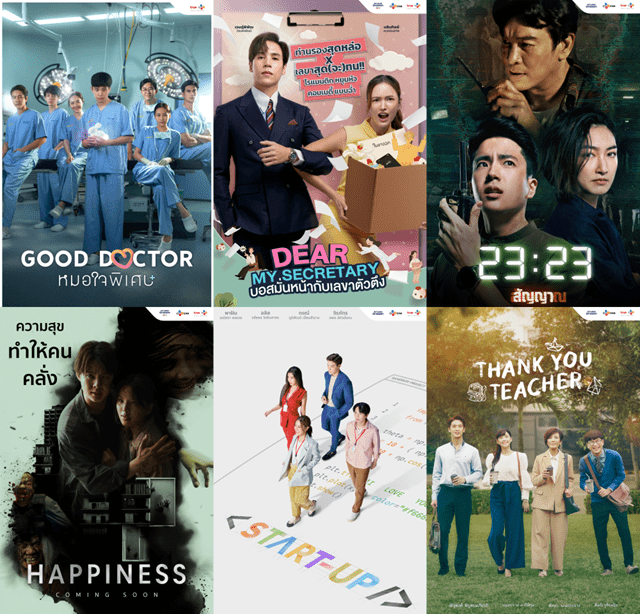
Maintaining the Unique Color of K-Dramas Amidst Foreign Capital and LocalizationProduction Control Also a Variable"While the Pool for Actor Advancements Has Widened"... Burden of Expectations and Country-Specific IssuesCJ ENM's Hong Kong subsidiary released six Thai co-produced dramas based on Korean works on an Indian OTT platform. /CJ ENMAs K-drama production costs rise and the investment environment for global OTTs changes, domestic production companies are exploring new production methods. One of these is 'global co-production,' which involves collaboration with overseas production companies and platforms. Cases of sharing production costs and jointly pursuing entry into local markets with various countries such as Japan, the United States, and Thailand are continuing. Amidst the changing K-drama production environment, we examine the current state of global co-production, the concerns on-site, and future challenges.
[THE FACT|Reporter Kim Saet-byeol] As global co-productions, where overseas production companies and platforms participate from the planning stage of K-dramas, increase, domestic content industry concerns are also deepening. While there are advantages in securing production costs and overseas distribution networks, there are also concerns that the unique emotions and identity of Korean content may be diluted in the process of reflecting the demands of the local market.The first aspect to consider is the creative direction. Works targeting the global market must consider viewers from multiple countries. While it is necessary to reflect local cultures and sentiments and consider the tastes of each market, excessive consideration can blur the unique color of the work. We must also consider how to maintain the unique narrative characteristics of Korean content that have garnered attention overseas, such as fast-paced development and dense emotional lines.In fact, production companies participating in global co-productions also cited maintaining the identity of the work as an important task. An official, identified as Mr. A, explained, "We are most wary of losing the unique color of the work by making it a co-production for the sake of co-production," adding, "If we try to satisfy all targets of various nationalities, there is a risk that the story will become superficial."There are also considerable production variables that arise during the collaboration process. Delays in decision-making due to language barriers and cultural differences can lead to budget overruns or schedule delays. Mr. A emphasized, "There are many risks of extended decision-making processes, ultimately leading to budget overruns or schedule delays," and stressed, "Preparation is needed to prevent this in advance."The differing production systems and decision-making structures of each country are also variables. In Korea, many projects are led by production companies in overall production, from fundraising to securing original works, script development, and casting. In contrast, Japan utilizes a production committee system involving various stakeholders such as broadcasters, advertising companies, publishers, and distributors. As there are multiple investors, rights and decision-making authority can be dispersed.Of course, there are differences depending on the work and contract structure, but as production practices vary by country, coordinating production direction and work authority during collaboration becomes important.Above all, the most sensitive issue is IP control. As the number of participating stakeholders in co-productions increases, the relationships regarding rights also become complex, including rights to original works and their screen adaptations, production of subsequent seasons, remakes, and utilization of secondary copyrights. The interests surrounding profit distribution and ownership of rights can differ depending on who bears how much of the production costs. If domestic production companies, in their focus on attracting foreign capital, fail to secure sufficient IP and business rights that can be utilized in the long term, the achievements of co-production may be limited.Mr. A pointed out the importance of maintaining control over planning and creativity, even with the infusion of global capital. He stated, "In terms of rights, we prioritize securing co-copyright, but depending on the situation, we focus on retaining rights for specific regions or preferential negotiation rights for future remakes." He added, "While short-term profit generation is important, conditions that can guarantee the sustainable growth of the production company are essential."In fact, there have been cases where conflicts over contract interpretation and authority have led to disputes. Disagreements over global distribution rights and contract interpretation arose between Plus X Entertainment and Thai Theme Work Studio regarding the short-form co-production projects 'Devil's Kiss' and 'Love in the Border Area,' which were co-produced by Korea and Thailand.Plus X Entertainment explained that there were differences in the interpretation of the legal effect of the contract documents and the notation of distribution and marketing rights in the end credits. Consequently, they appointed a law firm and considered legal action. An official stated, "We are proceeding with the necessary procedures to confirm the rights based on the contract and to ensure the scheduled global distribution proceeds without disruption." This highlights the importance of clearly defining rights and responsibilities from the contract stage in the co-production process.While the trend of global co-productions is increasing, concerns also exist. In particular, legal disputes have recently arisen over contract issues such as IP, making the establishment of a systematic framework even more necessary. /Plus X EntertainmentThe expansion of global co-production is bringing about changes not only for production companies but also for actors' spheres of activity. As the number of works involving overseas production companies and platforms increases, opportunities and choices for domestic actors to participate in overseas projects have expanded. It is explained that as the experiences of senior actors who have already entered overseas markets accumulate, the scope for the next generation to challenge themselves is also expanding.An official from an actor's agency, identified as Mr. B, stated, "We expect positive effects from the expanded pool of opportunities for our actors to advance overseas. Thanks to the senior actors who have already set foot overseas, that pool has also widened compared to before."However, with the increased opportunities come increased burdens. As the title of global co-production raises expectations for the work, the disappointment can also be greater if the actual released product does not meet those expectations.In particular, the differing social and cultural backgrounds and sensitive issues of each country are significant variables. It is also possible that problems not anticipated before the release of the work may arise in a particular country.Mr. B confessed, "Global co-productions generally attract attention," adding, "In this process, because the issues in each country are different, there is also anxiety about not knowing where and how problems might erupt."Global co-production is an opportunity for domestic content to expand its sphere of activity into overseas markets while simultaneously expanding its production capabilities. It can also be a new avenue for actors. However, simply increasing the scale of collaboration cannot guarantee success.A structure that balances the coordination of production environments and interests of each country while protecting creative control and IP rights has become more important than ever. Combining the demands of the overseas market with the unique competitiveness of K-dramas in a balanced way is a challenge that must be overcome for global co-production to establish itself as a sustainable growth model. [The Era of Co-production 1] K-Dramas Breaking Down Borders... Will Co-production Become a New Survival Strategy?[The Era of Co-production 2] Different Perspectives, One Work... Changes in the Global Collaboration Scenesstar1204@tf.co.kr[Entertainment Department | ssent@tf.co.kr]