
[Kang Il-hong's Close-up] The 'Paradox' of K-POP: Small and Medium Agencies Create, Large Agencies 'Monopolize' the Fruits
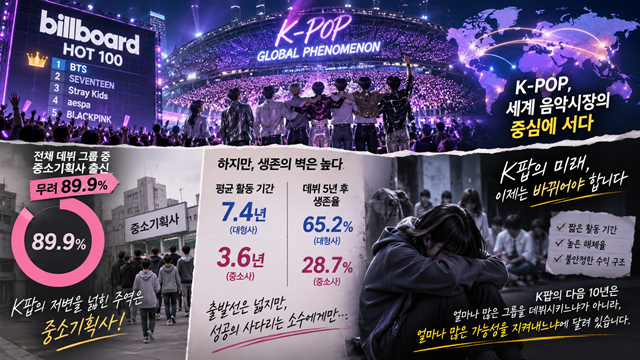 Analysis of 1159 Debut Groups from 1996-2025... The Paradox of 89.9% from Small to Medium-Sized AgenciesAverage Activity Period: Large Agencies 7.4 Years vs. Small/Medium Agencies 3.6 Years... Survival Rate Also Doubles[THE FACT|Reporter Kang Il-hong] K-POP has emerged as the center of the global music market. It dominates the Billboard charts, fills stadiums worldwide, and elevates the status of Korean popular culture. However, beneath the dazzling success lies a far less glamorous reality. While a significant number of new idol groups supporting K-pop's future are born from small to medium-sized agencies, it is the groups affiliated with large agencies that are concentrated among those who survive and grow into key players in the industry.Recent data analyzing 1159 idol groups that debuted between 1996 and 2025 starkly illustrates the structural imbalance within the K-pop industry. A staggering 89.9% of all debuted groups originate from small to medium-sized agencies. This means that out of every ten teams, AHOF teams are brought into the world through the planning, investment, and challenges of small to medium-sized agencies. This indicates that large agencies are not the sole drivers in expanding K-pop's reach, experimenting with new genres and concepts, and forming the foundation of the idol market.The problem lies in what follows. The average activity period for groups from large agencies is 7 years and 4 months, while for groups from small to medium-sized agencies, it is only 3 years and 6 months. The percentage of groups continuing their activities five years after debut also shows a significant gap, with 65.2% for large agencies and 28.7% for small to medium-sized agencies. Although there is an overwhelming number of groups from small to medium-sized agencies at the starting line, large agencies are far more advantageous in the survival competition. While the base for discovering new talent is broad, the ladder to success is open only to a select few.The average activity period for groups from large agencies is 7.4 years, while for groups from small to medium-sized agencies, it is only 3.6 years. The photo shows Black Pink, ROSÉ, JENNIE, JISOO, and LISA (from left) from YG, a major agency (Photo by Seo Ye-won).◆ Idol Industry Success Requires Massive Capital for Albums, Promotion, and Overseas PromotionWhy does this disparity occur? The idol industry is not a market where success is determined solely by singing, dancing, looks, and talent. It requires substantial capital and infrastructure, from years of pre-debut training costs to album production, music videos, promotion, broadcast appearances, and overseas promotion. Debut is not the end, but rather the beginning of significant investment and competition. Large agencies possess capital, brand recognition, fandom management systems, and global distribution networks. Even if the performance of one group falls short of expectations, they have the capacity to diversify risk across other artists and business divisions.In contrast, small to medium-sized agencies often stake the company's fate on a single new group. If the debut album does not sell as expected or if supplementary revenue from concerts and endorsements is not generated, it becomes difficult to guarantee the production of the next album. Even with talent and potential, the harsh reality for small to medium-sized agencies is that artists disappear from the stage if there is no capital to sustain them. If an industry that produces AHOF out of ten teams sees them pushed off the stage within a few years, it cannot be considered a healthy ecosystem.Of course, there is no issue with the success of large agencies. It is the result of securing competitiveness through long-term investment, planning, and professional systems. The problem lies in the fact that small to medium-sized agencies, which create the diversity of the entire industry, do not even get sufficient opportunities to share in the fruits of growth. While the success of large agencies may signify industry growth, the K-pop ecosystem as a whole cannot be deemed healthy based solely on the success of a few major players.Practical survival measures are needed, including production financing support for small to medium-sized agencies, transparent and fair distribution and settlement structures, the establishment of joint infrastructure for overseas expansion, and the protection of the rights and interests of new artists. The photo shows FIFTY FIFTY, a group created by small to medium-sized agency Attrakt, which showed potential but made a comeback after a period of turmoil (Photo by Seo Ye-won).◆ Practical Survival Measures Needed, Including Joint Infrastructure for Overseas Expansion for Small to Medium-Sized AgenciesWhat is even more concerning is that this polarization could, in the long run, stifle K-pop's creativity and diversity. New music, unique concepts, and experiments that break existing formulas often originate from smaller agencies. While large agencies lead the market, small to medium-sized agencies serve as laboratories for discovering new possibilities. If their survival base collapses, K-pop risks becoming an industry that merely repeats proven success formulas. The paradox of a flood of new groups emerging while new stars and musical innovations decline could arise.Now, policy attention for the K-pop industry should not be limited to the number of debut groups or overseas expansion achievements. Practical survival measures are needed, including production financing support for small to medium-sized agencies, transparent and fair distribution and settlement structures, the establishment of joint infrastructure for overseas expansion, and the protection of the rights and interests of new artists. It is not enough to simply provide financial support; an environment must be created where small to medium-sized agencies can secure independent competitiveness and continuously nurture artists.K-pop's competitiveness is not determined by the names of a few global stars or the market capitalization of large agencies. The true strength of the industry is shown by how many new artists emerge and how long they can remain active. The foundation of K-pop is built by small to medium-sized agencies, and the fruits of success are reaped by large agencies. This imbalance must now change. K-pop's next decade will depend not on how many groups debut, but on how many possibilities are preserved.eel@tf.co.kr
- HOT NEWS
- Park Si-woo 'Fluttering Gaze' [TF Photo Studio]
- (G)I-DLE Miyeon reveals striped makeup with cat ear hat
- Park Bo-gum, exuding masculinity in an all-black suit... elegance that heated up LA
- Kim Yun-seok 'Welcome, Exchange Student' [Photo]
- This K-Drama Just Hit No.1 in Brand Reputation Its “Tense” Keywords Explain Why

허블 정보
Copyright © 2017 Huvle All Rights Reserved
admin@huvle.com