
[TF Focus] Is 'Eok Rap' an Essential Element or a Hindrance in K-Pop?
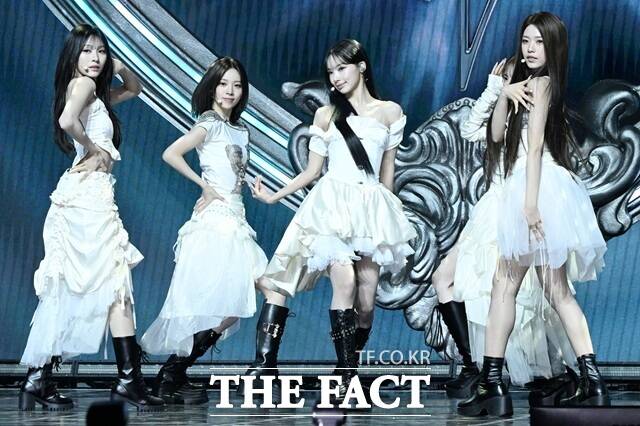 Conflicting reactions grow around 'forced rap'Trend of recognizing and enjoying it as a key characteristic of K-popSome tracks on the fourth mini-album 'PULSE,' released by group RESCENE on the 3rd, are polarizing opinions regarding so-called 'forced rap.' The photo shows RESCENE performing 'With' at the media showcase for the release of 'PULSE' held at the Our WON Banking Hall in Blue Square, Yongsan-gu, Seoul on the 3rd. / Reporter Kim Sung-ryeol[THE FACT|Reporter Choi Hyun-jung] 'Forced rap' is once again a hot topic in the K-pop scene.'Forced rap' is an abbreviation of 'forced rap,' a term created to criticize rap parts in K-pop that are forcibly inserted without considering the overall flow or mood of the music. However, recently, voices defending this 'forced rap,' arguing that it would be too bland and dull without it, are growing louder.The most recent example that best illustrates these conflicting reactions to 'forced rap' is the fourth mini-album 'PULSE' by RESCENE, released on the 3rd. This is because after the album's release, debates over the pros and cons of 'forced rap' erupted on social media and online communities.The song most frequently mentioned as having 'forced rap' in the album is track 4, 'MEME.' The rap part that appears around 1 minute and 25 seconds has received considerable support for its opinion that it does not fit well with the overall mood and feels forcibly inserted, hindering the song's flow.Coincidentally, 'MEME' ranks relatively low among the 5 tracks included in 'PULSE' on major music charts, further supporting this assessment of 'forced rap.'Additionally, there are opinions that the rap part in the title track 'With' was unnecessary, as the song emphasizes the vocal melody line. On the other hand, many reactions state that the rap part is not particularly bothersome or strange and is enjoyable, with some arguing that the rap part enhances the 'unique flavor of K-pop.'Here, RESCENE and 'MEME' are just examples, and what is noteworthy is the conflicting reactions surrounding 'forced rap.'As mentioned earlier, 'forced rap' was not originally a term with positive connotations. The reasons for criticizing 'forced rap' are relatively clear. Critics point out that attempts to forcibly insert rap parts often disrupt the song's flow or mood, and that rap parts are inserted simply due to member positions or result in low-quality rap.Recently, videos compiling 'forced rap' have gained significant popularity on YouTube. DAHYUN of group TWICE is considered an authority on 'K-pop forced rap.' / YouTube 'Me' channel captureHowever, as the history of rap parts in K-pop has lengthened, an increasing number of listeners are now consuming this 'forced rap' as a meme or, furthermore, accepting it as an essential element that defines K-pop.In fact, inserting rap parts in the middle of songs in K-pop is a compositional technique with a long tradition, dating back to the first-generation groups, even before the term 'K-pop' emerged. This means that 'K-pop rap parts' have become familiar to people.Of course, a long history and familiarity do not necessarily guarantee high quality. Moreover, no matter how well a rap part is made, if it doesn't fit the main music, the criticism of it being 'forcibly inserted rap' will not disappear.However, recent K-pop fans tend to enjoy this 'forcedness' and 'randomness' of 'forced rap,' viewing it as a 'charm of K-pop.' For instance, the video 'The Taste of Forced Rap (Positive)' compiled and edited by YouTuber 'Me' garnered 1.47 million views within six days of its upload, achieving great popularity.Furthermore, comments on the video include evaluations like 'It's the foundation of K-pop and a seasoning that maximizes the taste of K-pop,' accurately reflecting listeners' perceptions of 'forced rap.'So, how do K-pop producers view this 'forced rap'? As individuals who directly produce and present K-pop groups, they tend to see 'forced rap' not as a matter of preference but as a marketing strategy.A K-pop producer, who requested anonymity, told
- HOT NEWS
- vVardis Raises $175 Million Ahead of NYSE IPO: NYSE Content Update
- HTL Biotechnology launches HTL8, a production unit dedicated to pharmaceutical-grade polynucleotides (DNA)
- Perfect Crown Dodges a Formal Penalty — But the Scars From Its Historical-Accuracy Firestorm Haven’t Faded
- Haier Energy Launches 12-20 kW AI Hybrid Inverter Series
- TWS, Band Live of 'Call My Name' on 'It's Live'

허블 정보
Copyright © 2017 Huvle All Rights Reserved
admin@huvle.com