
Univers expands global Physical AI ecosystem to make critical infrastructure intelligent
Partnerships with World Green Building Council, Mærsk Mc-Kinney Møller Center for Zero Carbon Shipping and XIBER Energy Solutions extend Physical AI across buildings, maritime and industry, building on Univers' growing global ecosystem
ANTALYA, Türkiye, Nov. 16, 2026 /PRNewswire/ -- Univers, a Singapore-headquartered global leader in Physical AI for intelligent infrastructure, today announced three separate global partnerships, each aimed at accelerating the application of Physical AI across the built environment, maritime and industrial operations.
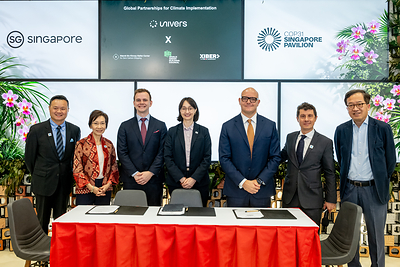
The separate agreements with World Green Building Council, Mærsk Mc-Kinney Møller Center for Zero Carbon Shipping and XIBER Energy Solutions were signed at the Singapore Pavilion at COP31, with the signing ceremony witnessed by Singapore's Minister for Sustainability and the Environment Grace Fu. While distinct in scope, the three collaborations extend the application of Physical AI across major areas of the physical economy: the built environment, maritime and industrial operations.
As energy and infrastructure systems become more electrified and interconnected, the challenge is shifting from climate ambition to implementation. Univers's Platform for Physical AI connects operational technology, information technology and AI to help organisations understand, optimise and orchestrate complex physical systems at scale.
Valerio Dilda, Senior Vice President of Europe, Univers, said:
"The world has set its climate ambitions. The next challenge is implementation across the physical economy. By combining our partners' deep domain expertise with Univers's Physical AI capabilities, we can help countries accelerate the energy transition towards energy systems that are sustainable, resilient, affordable and sovereign, while scaling proven approaches across markets."
Taking Physical AI into global industries
As World Green Building Council's first AI Global Knowledge Partner, Univers will work with its global network to advance the role of AI in more intelligent building operations and sustainable infrastructure. The partnership creates an opportunity to bring Physical AI expertise into a global network focused on accelerating built-environment decarbonisation.
Cristina Gamboa, CEO, World Green Building Council, said:
"Decarbonising the built environment requires us to go beyond measuring performance to continuously improving how buildings actually operate. This partnership will explore how AI can enable buildings to become more intelligent, responsive and sustainable at scale."
Through its partnership with XIBER Energy Solutions, TESYA Group's in-house decarbonisation start-up, Univers will implement Physical AI across XIBER Energy Solutions' global industrial and manufacturing customer base, helping businesses improve energy and operational performance and reduce emissions.
Giovanni Longari, CEO, XIBER Energy Solutions, said:
"Industrial decarbonisation has to deliver tangible results on the factory floor. Bringing AI together with real operational and energy data can help manufacturers improve productivity and energy performance while reducing emissions."
Univers will also become one of the first AI partners of the Mærsk Mc-Kinney Møller Center for Zero Carbon Shipping, working together on systemic maritime decarbonisation. The collaboration will explore how AI can improve maritime operations, including through a Return on Intelligence framework focused on the economic and environmental value of more intelligent operational decisions.
Pernille Dahlgaard, Chief Impact Officer, Mærsk Mc-Kinney Møller Center for Zero Carbon Shipping, said:
"Maritime decarbonisation is a systems challenge. AI has the potential to connect decisions across vessels, fuels, ports and operations, translating intelligence into measurable operational, economic and environmental outcomes."
The partnerships also coincide with the launch of Univers' new Return on Intelligence framework at COP31, which proposes a new way for businesses to assess the value created by AI in physical operations. The framework is explored in a new whitepaper with input from Mærsk Mc-Kinney Møller Center for Zero Carbon Shipping. Entitled Return on Intelligence: How AI Changes the Economics of Transport, it is being launched at COP31 with perspectives from across the transport, energy and financial ecosystem.
Fox Chu, Senior Vice President and Global Head of Aviation, Transportation & Logistics, Univers said:
"Rather than measuring AI primarily through technology performance or emissions reduction, the framework looks at how better operational decisions create enterprise value, including through improved capital productivity, stronger operating economics, new revenue opportunities and the removal of constraints to growth."
Building global momentum for Physical AI
The COP31 partnerships form part of a wider expansion of Univers's Physical AI ecosystem and build upon partnerships signed ahead of COP31.
Ahead of COP31, Univers expanded its partnership with Voltalis in Europe to turn commercial building portfolios into flexible grid assets. Following the strong start in the UK and France announced in June, the partners are now beginning to explore opportunities in new regions. The collaboration brings together demand-side flexibility and Physical AI to help buildings respond more intelligently to grid and market conditions.
In Singapore, Univers is also deepening its strategic partnership with SBS Transit, extending its collaboration into Physical AI for energy and operations, beginning with e-bus operations and exploring applications in rail maintenance.
Together, these distinct collaborations extend Univers's Physical AI ecosystem across buildings, energy, public transport, maritime and industry, demonstrating how intelligence can be applied to real-world infrastructure and scaled across sectors and markets.
About Univers
Univers is a global leader in Physical AI for energy and infrastructure. Its Platform for Physical AI brings together operational technology, information technology and AI to help organisations understand, optimise and orchestrate complex physical systems. Headquartered in Singapore and operating globally, Univers works across energy, buildings, transportation and industry to make infrastructure more intelligent, efficient, resilient and sustainable. Currently, over 450 million devices and sensors are connected and approximately 20% of global renewable capacity runs through Univers's technology across 45 markets around the world.
For more information, please visit univers.com.
View original content to download multimedia:https://www.prnewswire.com/apac/news-releases/univers-expands-global-physical-ai-ecosystem-to-make-critical-infrastructure-intelligent-302940416.html
SOURCE Univers
- HOT NEWS
- Pony.ai and Toyota Launch Fully Driverless Commercial Services with Gen-7 bZ4X Robotaxi
- [TF Focus] KBS Historical Drama Returns... Will 'Moonmu' Write a New History?
- Xinhua Silk Road: Smart tech drives modern agriculture development in Zaozhuang, Shandong
- Sunmi reveals bright winter daily look with white fur coat, bob haircut, and pink heart pin
- LifeWave APAC Summit Tour Draws Nearly 20,000 Attendees



허블 정보
Copyright © 2017 Huvle All Rights Reserved
admin@huvle.com