
Embracing COP31 as a 'COP of Implementation': Side event explores pathways for global climate diplomacy and cooperation
ANKARA, Turkey, Nov. 20, 2026 /PRNewswire/ -- A thematic side event titled "From Early Warning to Energy Action: Pathways for Global Climate Diplomacy and Cooperation" was held on the afternoon of November 13 local time at the Global Alliance of Universities on Climate during the 31st Conference of the Parties (COP31) to the United Nations Framework Convention on Climate Change.
The event was jointly hosted by the United Nations Institute for Training and Research and the Public Meteorological Service Centre of the China Meteorological Administration (National Early Warning Information Release Center), with strategic support from China Energy News, the foreign affairs working committee of the China Energy Research Society (CERS), and the China Institute of Energy Economics Research.
Representatives from Russia, China and various international organizations, including the World Meteorological Organization (WMO) and the International Renewable Energy Agency (IRENA), attended the event. Participants held in-depth discussions on climate risk prevention, early warning systems, energy transition and international cooperation, exploring ways to effectively translate climate warnings into concrete energy actions.
At the event, the Climate Leadership Impact (CLI) platform presented its first bilingual report in Chinese and English, titled "From Early Warning to Energy Action: 2026 Innovation Showcase on China's Corporate Actions and Collaborative Practices."
The report highlights how measurable and replicable industrial practices can contribute to COP31's theme of a "COP of Implementation." Focusing on preventing climate disasters and enhancing climate resilience, it explores energy-led approaches to climate action, with the aim of bringing greater certainty and positive momentum to global climate governance.
Joint efforts to translate early warnings into energy action
The World Meteorological Organization's (WMO) State of the Global Climate Update 2026, released during the conference, shows that the global average surface temperature in the first nine months of 2026 was approximately 1.47 degrees above pre-industrial levels. An exceptionally strong El Niño event is expected to further intensify high temperatures and extreme weather, with impacts likely to continue into 2027. The number of countries with multi-hazard early warning systems has increased from 56 in 2015 to 136 in 2025.
Meanwhile, the UN Environment Programme's Adaptation Gap Report 2026 estimates that developing countries will need approximately $305 billion annually in adaptation financing by 2035. Even if the target of tripling international public adaptation finance is achieved, it would cover only around 20 to 30 percent of the estimated needs. While early warning coverage is expanding, funding, institutional mechanisms and capacity have not kept pace.
Sergey Kononuchenko, special representative of the Russian Foreign Ministry for climate issues and ambassador-at-large, said in his address that climate change is an urgent challenge facing humanity and that the priority now is to translate commitments into concrete action.
He stressed the need to strengthen early warning systems through technological innovation, including artificial intelligence and satellite observation, to protect critical energy infrastructure; uphold multilateralism and ensure developing countries have equitable access to early warning technologies and capacity-building opportunities; and urge all parties, particularly developed countries, to honor their commitments on climate financing and technology transfer. He also recognized China's achievements in building the world's largest renewable energy system and carbon emissions trading market, expressing hope that COP31 would serve as a platform for practical action.
"Early warning is not the end point, but the starting point for action," said Sun Zhengyun, vice chairman and secretary-general of the CERS.
He noted that improvements in forecasting capabilities do not necessarily translate into stronger response capacities. To bridge this gap, Sun said, efforts should first be made to effectively connect climate early warnings with power grid dispatch, renewable energy generation forecasting, energy storage management and emergency response, ensuring that warning information is genuinely incorporated into energy system operations.
Climate risk management should also be strengthened in energy planning and investment decisions to improve the resilience of projects from the outset. In addition, international cooperation should be deepened, with greater emphasis on capacity building in developing countries, enabling more regions to develop comprehensive capabilities to translate early warnings into action.
Xie Rongbin, Party secretary, chairman and editor-in-chief of China Energy and Automobile Media Group Co Ltd, president of China Automotive News, and editor-in-chief of China Energy News, said the global energy transition is a systemic transformation requiring the coordinated management of climate risk early warnings, technological innovation, industrial collaboration, market mechanisms, security safeguards and equitable development.
The key, Xie said, is to turn early warning capabilities into effective emergency responses. China is actively exploring ways to integrate meteorological warnings with energy dispatch, while using technology to strengthen the resilience of energy systems against extreme weather shocks. In July this year, China's installed solar power capacity surpassed that of coal-fired power, making solar the country's largest source of installed power capacity.
Andrew Tupper, head of the Early Warning Services at the WMO, expressed agreement with this approach. He noted that conventional, general-purpose weather warnings are no longer sufficient to meet current needs. There is an urgent need to establish "impact-based early warning systems" that connect meteorological information with energy operations, enabling warnings to trigger timely and targeted protective measures for energy assets.
Bridging meteorology and energy through cross-sector collaboration
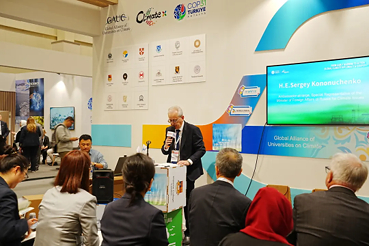
As a core member of the research team behind the report From Climate Early Warnings to Energy Action: 2026 Progress Report on Chinese Enterprises' Actions and Collaborative Practices, Dr. Wang Jingyu, assistant director of the national key laboratory of advanced electromagnetic technology at Huazhong University of Science and Technology and an associate research fellow, presented the CLI platform's first bilingual report in Chinese and English.
Wang said the report features 16 practical case studies across six categories, covering renewable energy output forecasting, infrastructure protection, power grid dispatch and maintenance, energy security for key users, supply-demand adjustment, and emissions reduction and carbon sequestration.
Ye Dong, a senior researcher at the Public Meteorological Service Centre of the China Meteorological Administration, introduced initiatives to harness AI for energy-related meteorological and climate services under the theme "From Accurate Forecasting to Enhanced Climate Resilience."
Ye noted that meteorological conditions have a profound impact on the entire energy chain, from production and transmission to consumption. As global climate change intensifies, extreme weather poses increasingly prominent threats to energy systems. Meanwhile, non-disaster weather conditions with significant impacts, such as prolonged periods of weak winds and reduced sunshine, can also cause fluctuations in renewable energy output and disrupt the balance between electricity supply and demand.
Specialized meteorological early warning services for the energy sector are therefore essential to ensuring energy security and strengthening the climate resilience of energy systems, Ye said.
China is actively developing AI-based meteorological forecasting models tailored to energy-sector applications, drawing on domestically developed satellites and multi-source observation data. Ye stressed that AI is merely a technological tool, and that the key is to address real-world operational needs and translate accurate weather forecasts and warnings into concrete measures for protecting energy facilities, power dispatch and risk response.
Practical applications on the power grid side have already established a complete chain from forecasting to response. State Grid Shaanxi Electric Power, drawing on standardized observation systems at power stations and the "Fuxi" meteorological foundation model, has achieved an accuracy rate of 95.2 percent in short-term power output forecasting. Its icing warnings now provide an additional 18 hours of lead time, while the initiative has cumulatively enabled an additional 65.05 million kilowatt-hours of renewable electricity generation.
State Grid Zhoushan Power Supply Company in East China's Zhejiang Province has used a large AI model to coordinate preparations before disasters, emergency response during disasters and post-disaster repairs, reducing the average time needed to complete the fault-resolution process from eight hours to 4.7 hours.
On the enterprise side, early warnings are being translated into economic returns and asset protection. China Resources Power Technology Institute has developed an integrated climate and energy storage management platform. Based on operational data from a wind power project equipped with energy storage in Central China's Hubei Province during the first half of this year, the platform is estimated to reduce renewable energy curtailment by 92.6 percent and increase overall economic benefits by more than 10 million yuan.
Trina Solar has integrated module protection, grid-forming energy storage, and intelligent operation and maintenance. Estimates based on a 100-megawatt solar project in Texas, the US, indicate that the approach could reduce average annual asset losses by 94 percent, demonstrating the potential for similar solutions to be replicated in overseas regions facing high climate risks.
Policy support is also creating an institutional framework for closer coordination between meteorology and the energy sector. In January this year, the China Meteorological Administration and the National Energy Administration jointly issued guidelines on developing an energy meteorological service system, setting out 20 tasks and aiming to establish an integrated energy meteorological service system covering all energy-sector scenarios by 2027.
Tian Yuyang, assistant director of the foreign affairs working committee of the CERS, said the CLI platform would continue to advance its work across four areas: risk governance and financial support, AI-enabled forecasting and decision-making, coordinated clean energy dispatch, and interdisciplinary talent development. The goal is to translate research findings into operational applications and turn pilot experience into industry standards.

Under the theme "How can meteorological warnings be effectively translated into action within energy systems?" three representatives of international organizations – Tupper, Avishek Malla, head of renewable energy at the International Centre for Integrated Mountain Development (ICIMOD), and Binu Parthan, deputy director of country engagement and partnerships at IRENA – joined enterprise representatives, including Wu Xiao, vice president of Trina Solar and head of the group's ESG management and risk control, and Han Shutong, general manager of LONGi Green Energy Technology's UK representative office, for an in-depth discussion. The session was moderated by He Chaoxin, chief youth officer of the Global Alliance of Universities on Climate.
Tupper pointed out that the bottleneck in cross-sector collaboration lies not in information sharing itself, but in whether energy departments genuinely rely on meteorological warnings when making dispatch decisions. Without trust built through long-term cooperation, warnings may remain merely reference information rather than becoming a basis for decision-making.
The WMO is now incorporating this model of trust-based collaboration into its global early warning framework, promoting a shift from basic cooperation between meteorological and energy departments toward substantive operational coordination, Tupper said.
Malla presented practical achievements in mountainous areas of South Asia. ICIMOD has established a multi-tiered early warning system that includes high-resolution forecasts up to 54 hours ahead, flood forecasts 10 to 15 days in advance and glacial lake outburst monitoring. Information is shared with government departments and local communities, while text messages and alerts are used to deliver warnings directly to the public.
The center is also incorporating climate data into sensitivity analysis models used by hydropower investors and commercial banks, opening up new channels for integrating climate information into risk assessments of energy infrastructure.
Parthan focused on the implementation stage after warnings are issued. Taking heatwaves as an example, he noted that high temperatures both reduce the transmission capacity of power lines and drive up electricity demand for cooling. However, such warning information has not yet been effectively incorporated into the operational planning of utility companies.
He proposed bringing together multiple stakeholders, including power grid planners, government departments, system operators and financial institutions, to establish cross-sector mechanisms for short-term decision-making. This would enable early warning information to directly inform real-time energy system dispatch and investment decisions.
Participants agreed that the main bottleneck in translating early warnings into action is shifting from meteorological technology to the operational rules of energy systems. The CLI platform's first progress report is a response to this challenge. By turning the practical experience of Chinese enterprises in dispatch response, resilience upgrades and cross-border cooperation into measurable and replicable industry references, the report aims to help transform COP31's theme of a "COP of Implementation" from a conference slogan into concrete action within energy systems.
During the conference, China's approaches also offered developing countries new options for addressing gaps in their climate response capabilities.
On November 11, China's AI-powered meteorological early warning solution, the "Mazu" all-in-one system, was unveiled to a global audience at a high-level forum on South-South cooperation on climate change. As of October 2026, the system had been deployed in eight countries, including Pakistan, Ethiopia and Sri Lanka, and was undergoing cloud-based trials in more than 50 countries.
On November 12, He Yang, deputy head of the National Energy Administration, said at a high-level event on the Global Grid Accelerator initiative that China was willing to support countries in building power grids that ensure energy security and prosperity through a model of "shared provision."
View original content to download multimedia:https://www.prnewswire.com/apac/news-releases/embracing-cop31-as-a-cop-of-implementation-side-event-explores-pathways-for-global-climate-diplomacy-and-cooperation-302946731.html
SOURCE China Energy and Automobile Media Group
- HOT NEWS
- Archbridge Capital Partners Appoints Mark Jones as Chief Executive Officer
- Tam Jai International and Nan Fung Group Collaborate on Uniform Upcycling Project
- GFTN and LHoFT Partner to Launch the Future of Wealth Forum for AI, New Asset Classes and the Next Generation
- Louis Dreyfus Company and Neptune Robotics Partner on Robotic Hull Cleaning Programme under the Maritime and Port Authority of Singapore's Innovation Programme
- IU, 2027 Season's Greetings Released...She Removes Her Short Hair and Transforms into Long Straight Hair



허블 정보
Copyright © 2017 Huvle All Rights Reserved
admin@huvle.com