
Felix’s Hanbok Wave Photos Head to Six Overseas Cities
The Stray Kids member collaborates with five Korean designers for portraits set to appear on international screens from December.
Stray Kids’ Felix is bringing a new set of hanbok portraits to international screens through the 2026 Hanbok Wave project. South Korea’s Ministry of Culture, Sports and Tourism unveiled the collaboration on November 23, pairing the performer with five Korean hanbok designers.
The images are scheduled to begin appearing in the first week of December at Seoul Station’s Panorama display and on screens in six overseas cities: New York, Paris, Milan, Tokyo, Jakarta and Rio de Janeiro.
The rollout will take place in stages. It is a presentation of the project’s imagery, rather than an announcement that Felix will personally visit each location.
Five Designers, Five Approaches to Hanbok
The ministry’s official press kit identifies five participating brands, selected through an open call: 금의재, 단하, 리우앤비우, 서담화 and 한복스튜디오혜온.
Each approaches traditional clothing through a different design idea. According to the ministry, 금의재 combines vivid red clothing with a layered outer robe, emphasizing the depth created by overlapping garments. 단하, known as Danha, places the blue scenery of traditional Korean landscape painting onto a dopo, a traditional outer robe.
리우앤비우 draws on scrolling vine motifs associated with mother-of-pearl craft to expand the decorative treatment of a dopo. 서담화 translates the yin-and-yang principles of the eight trigrams into straight lines and segmented silhouettes.
한복스튜디오혜온 works with the cheollik, adding delicate embroidery and a red woven waist tie. Rather than treating hanbok as a single fixed appearance, the selection presents several ways of working with its forms, ornament and construction.
These distinctions give viewers a reason to look beyond the celebrity portrait. The garments are connected by their cultural starting point, while the designers retain separate visual identities.
Landscape Painting and Embroidery Come Into Focus
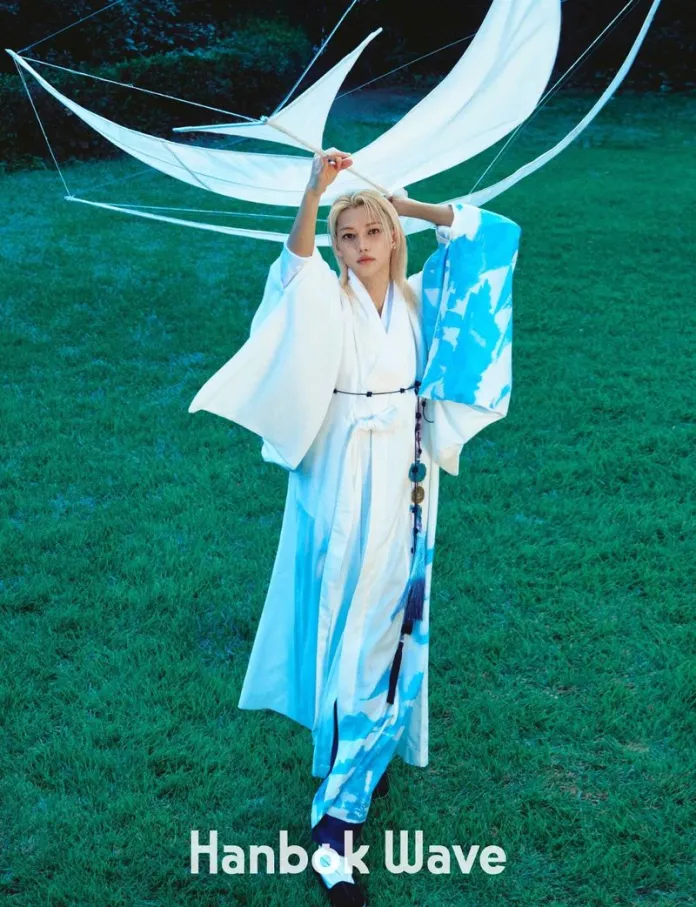
The released photographs make some of those ideas immediately visible. In Danha’s image, Felix wears a white robe carrying sweeping blue landscape details, raising his arms beneath suspended white fabric. The outdoor setting and flowing material extend the movement of the painted design.
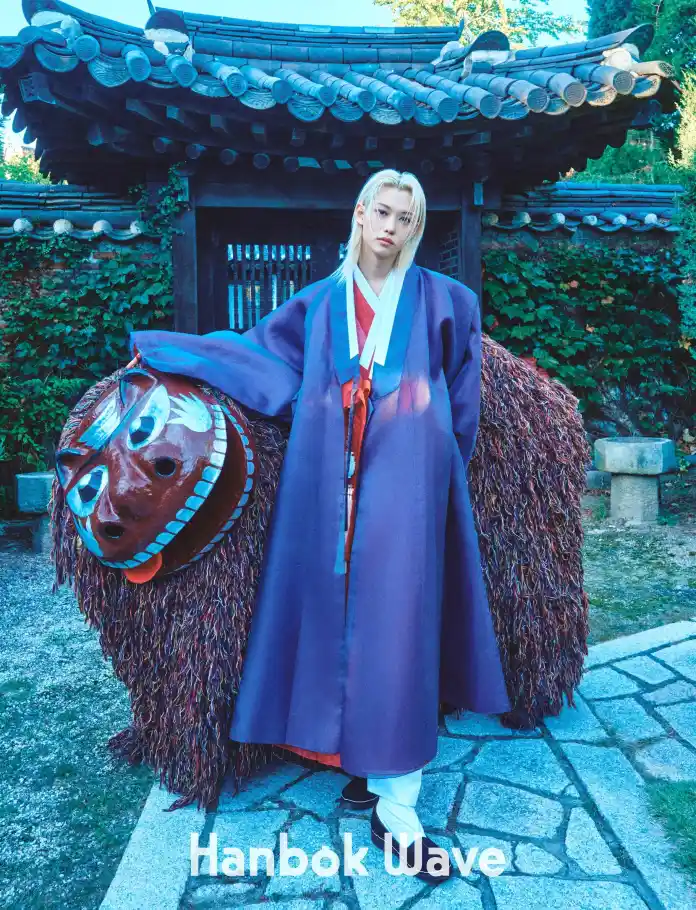
Another portrait shows him wearing Hanbok Studio Hyeon’s pale embroidered outfit beside traditional architecture. Blue light falls across the scene, drawing attention to the garment’s surface and the contrast between its soft color and decorative details.
Our analysis is that these images work through both distance and detail. Their silhouettes and color contrasts can register quickly on a public screen, while closer viewing reveals painting, embroidery and accessories. That gives the project different points of entry for someone encountering a billboard and someone spending more time with the editorial.
The photographs do not make every garment identical to contemporary everyday clothing. Instead, their styling invites viewers to see traditional forms as material for current fashion imagery.
Overseas Displays Expand the Project’s Reach
The ministry says Jakarta and Rio de Janeiro are new display locations for this year’s project. Their addition extends the campaign’s planned overseas presentation into Southeast Asia and South America.
The six-city list describes overseas locations; Seoul Station is a separate domestic venue. The announcement does not give a complete city-by-city timetable, so the first week of December should be understood as the start of the phased rollout.
Photographs and fashion-film content will also be shared through the ministry’s and the Korea Craft & Design Foundation’s official social channels. Marie Claire Korea will introduce Felix and the participating designers’ work, providing an editorial setting alongside the public-screen presentation.
Another Setting for Felix’s Fashion Presence
Felix has already appeared in international fashion settings covered by WIKIPICKY, including his Louis Vuitton show appearance alongside Lisa. Our earlier feature on his monochrome styling also explored how silhouette and contrast shape his fashion photographs.
Hanbok Wave gives that visibility a different purpose: introducing the work of Korean hanbok designers through a collaboration centered on traditional culture.
The program has previously featured Park Bo-gum, Kim Tae-ri, Suzy and Kim Yuna. Its stated purpose combines public promotion of hanbok with support for participating Korean brands’ international reach.
For the new edition, the most useful measure of its creative range is visible in the clothes themselves: five designers, sharing a cultural reference point, arrive at distinct results.
- HOT NEWS
- Singer Jiho, outing with family to see autumn foliage... sharing a warm and healing daily life
- G-Dragon’s ‘Good Day 2’ Adds Soyeon and 3RACHA
- "Moonmoo" Jang Hyuk and Kim Kang-woo face off with swords in episode 4... A psychological battle for the fate of Silla
- 'Good Partner' Returns for Season 2 with Jang Na-ra&Kim Hyeyoon&Pyo Ji-hoon&Park Hae-jin Taking a 'Deep Breath' [TF Photo Studio]
- Jung Seung-hwan leaves Antenna to join D.O. under the same roof


허블 정보
Copyright © 2017 Huvle All Rights Reserved
admin@huvle.com