
Why BLACKSWAN’s Rise Is Getting Attention as K-pop’s Best-Known All-Foreign Girl Group
K-pop has featured international members for years. But very few groups have pushed that idea as far as BLACKSWAN.
That is part of why the group keeps drawing attention.
In an industry still strongly associated with Korean trainees and Korean-born idols, BLACKSWAN stands out for a simple reason: the current group is made up entirely of non-Korean members. DR Music described the group in 2025 as consisting of Fatou, NVee, Gabi, and Sriya, and Yonhap also noted that BLACKSWAN is made up entirely of non-Korean members.
For many fans, that alone makes BLACKSWAN one of the most interesting groups in K-pop right now. But the group’s recent rise is not only about representation. It is also about visibility.
Over the past two years, BLACKSWAN has kept building a bigger international profile through new music, overseas touring, festival appearances, and global TV exposure. Their 2025 single “I Like It Hot” marked their first new release in about 10 months after the 2024 EP Roll Up, while Apple also featured the group in its K-pop ecosystem through projects including K-Pop Idols and the 2025 competition series KPOPPED.
What makes BLACKSWAN’s story especially interesting is that their popularity feels different from the usual K-pop growth narrative.
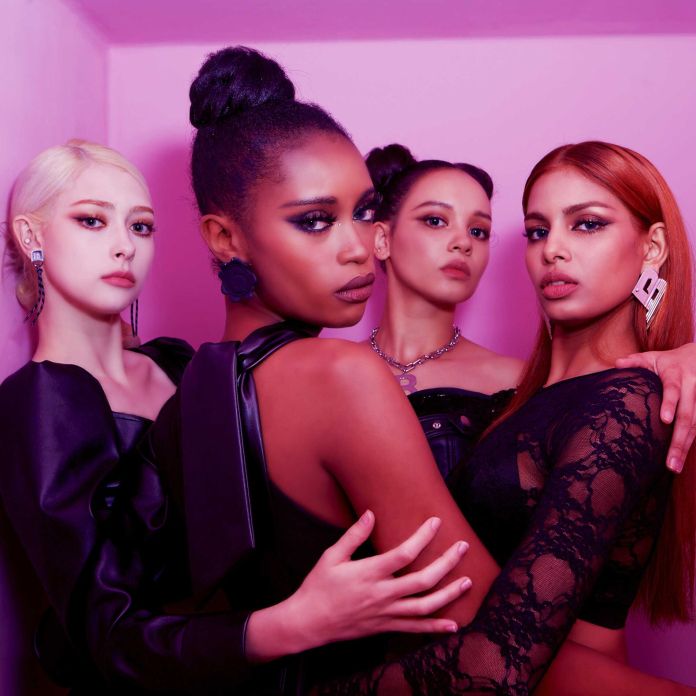
A group that breaks the usual image of K-pop
BLACKSWAN is not a newly launched survival-show act or a traditional Big 4 group with a massive domestic push behind it. Instead, the group has built attention partly because people keep asking the same question: what does K-pop look like when none of the members are Korean?
That question has become more visible in Korean media as well. In late 2025, Maeil Business Newspaper pointed to BLACKSWAN as one of the clearest examples in the debate over how K-pop is changing, noting that after the departure of the last Korean members, the group continued promoting in Korea and overseas, including in the United States and the Middle East.
That is a big reason BLACKSWAN keeps getting discussed beyond their songs alone. They are not just another girl group comeback. They are part of a larger conversation about how global K-pop has become.
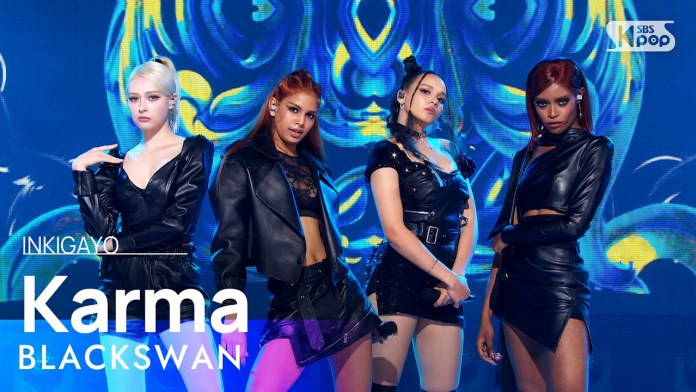
Why fans say the group feels different
For a lot of fans, BLACKSWAN’s appeal comes from how clearly each member represents a different cultural background while still performing within the K-pop system.
Fatou, who was born in Senegal and raised partly in Belgium, has become one of the group’s most recognizable faces. Sriya’s addition brought major attention in India, while Gabi and NVee have also helped shape the group’s image as one of the most internationally diverse acts in the scene. Their current four-member lineup has remained stable since 2023, which also helped give the group a more settled identity after years of lineup changes.
That stability matters because BLACKSWAN’s older history was often overshadowed by rebranding, member turnover, and company controversy. Now, fans are watching a version of the group that feels more defined.
Instead of being known only for “what makes them different,” BLACKSWAN is increasingly being noticed for what they are doing with that difference.
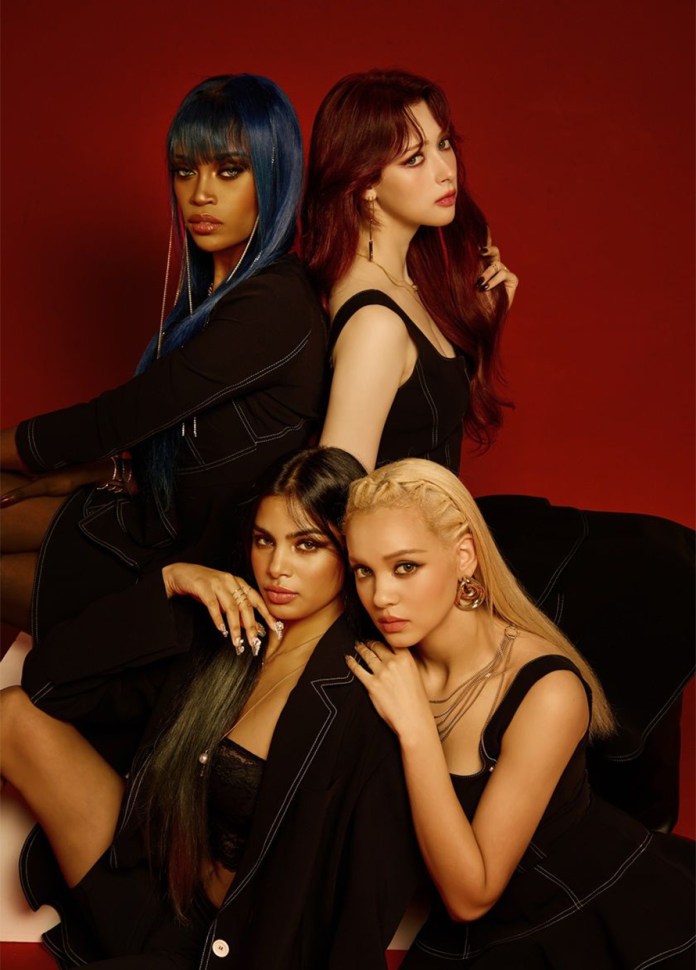
More visibility, more proof of momentum
The group’s recent activity gives fans a clearer reason to talk about growth rather than just novelty.
In 2025, BLACKSWAN returned with “I Like It Hot,” which Yonhap described as their first new music in roughly 10 months. The group also announced a four-city U.S. fan concert tour for June 2025, with stops in Chicago, Dallas, Atlanta, and Los Angeles.
That kind of activity matters because it shows a group moving beyond internet curiosity and into actual international fandom-building.
BLACKSWAN also gained added visibility from Apple’s music competition series KPOPPED, which premiered on August 29, 2025. Apple described the show as a format where Western music icons collaborate with K-pop idols to create new performances for a live audience. BLACKSWAN’s participation put them in front of viewers who may not have followed the group through standard K-pop channels.
For a group like BLACKSWAN, this kind of exposure can matter even more than chart numbers. It helps them reach casual viewers who might discover them through streaming shows, clips, or performance stages rather than through the usual fandom pipeline.
Blackswan Gabi has now met both the President of Brazil and South Korea!
— peach girlpic.twitter.com/v8LSKMmcDz
(@Nikie9door) February 24, 2026

Why their rise feels bigger than one comeback
What stands out about BLACKSWAN is not that they suddenly became a mainstream domestic powerhouse. It is that they have slowly built a place in the global K-pop conversation that almost no other group occupies.
They are unusual enough to make people curious, but now they also have enough activity behind them to make that curiosity last.
That may be the real reason their popularity keeps rising. BLACKSWAN is no longer just a “can this work?” story. More and more, they are becoming proof that there is room in K-pop for a group that does not fit the old template.
And in a genre that keeps calling itself global, BLACKSWAN may be one of the clearest tests of what that word really means.
- HOT NEWS
- Kim Yoo-jung Stuns With New Visual, Fans Say “I Thought It Was Song Hye-kyo”
- Did Sandara Park Unfollow Park Bom? Fans Notice Change After Recent Controversy
- Huawei's SuperPoD Portfolio Creates New Option for Global Computing at MWC Barcelona 2026
- Logitech Unveils Revitalized Hong Kong Office and Launches "Green Alliance" with ISVs
- Baskin Robbins Hints at Possible ITZY Yuna Collaboration Fans Notice Mysterious YouTube Comment



허블 정보
Copyright © 2017 Huvle All Rights Reserved
admin@huvle.com