
BIGBANG Returns to the Stadium Stage After 8 Years and 8 Months
BIGBANG Waited Nearly Nine Years for This Moment, Then Proved Its Hits Still Belong in a Stadium
BIGBANG’s 20th-anniversary concert carried the weight of an unusually long absence. It had been eight years and eight months since the group’s previous standalone concert, and the K-pop industry awaiting its return looked very different from the one BIGBANG had last toured.
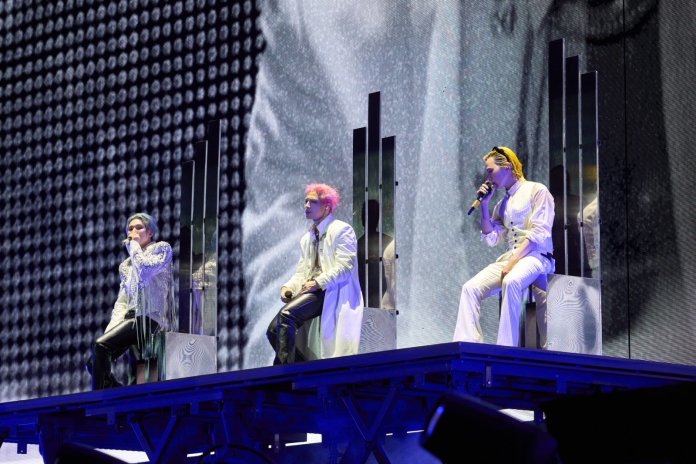
Yet when G-Dragon, Taeyang and Daesung opened the August 23 show at Goyang Stadium with “Fantastic Baby,” the performance did not require an introduction to explain why the song mattered. Thousands of fans raised BIGBANG’s crown-shaped light sticks and supplied the chorus themselves.
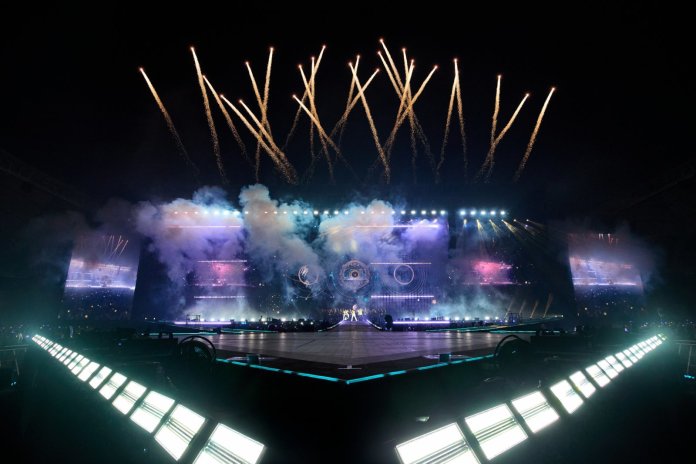
That response became the defining feature of the night. The concert was designed as a celebration of the group’s history, but it also tested whether BIGBANG could convert that history into a convincing present-day stadium show. Across two and a half hours, the current three-member lineup answered with a set that connected its biggest hits, individual careers and first new group single in more than four years.
A reunion built for a stadium
The August 23 concert concluded BIGBANG’s three-night opening run for its 2026-2027 world tour, “XX: COSMOS.” The Goyang shows took place from August 21 to 23 and sold out before the tour began, according to YG Entertainment.
Rather than easing into the performance, BIGBANG opened with a sequence of “Fantastic Baby,” “Hands Up” and “Tonight.” The selection immediately returned the audience to the group’s most explosive mode, but it also placed songs released more than a decade ago inside a modern stadium production.
The opening was followed by a different side of the group’s catalogue. “Blue,” “Loser,” “If You,” “Bad Boy” and “Bae Bae” shifted the emphasis from spectacle to the distinctive combination of rap, melody and emotional directness that helped BIGBANG stand apart during K-pop’s second generation.
“Haru Haru” and “Lies” became particularly important moments. Performed while the members were seated, the songs allowed the audience’s collective singing to carry much of the atmosphere. Their position in the show illustrated the scale of BIGBANG’s catalogue: these were not obscure tracks included for longtime fans, but songs that helped shape mainstream Korean pop during the late 2000s.
Three solo careers now strengthen the group
BIGBANG returned to touring after a period in which G-Dragon, Taeyang and Daesung had each developed increasingly independent musical identities. Instead of hiding that separation, “XX: COSMOS” incorporated it into the structure of the concert.
Daesung moved between “Universe,” “Wings,” “No More Big Bang” and his enduring trot-pop favorite “Look at Me, Gwisun.” Taeyang brought an R&B-centered section that included “Bad,” “Ringa Linga” and “Live Fast Die Slow,” while G-Dragon performed “Power,” “Crayon” and “Crooked.”
These stages did more than provide costume changes between group performances. They demonstrated why BIGBANG’s current format can still work after such a long interruption. Each member can command a section of a stadium independently, while their contrasting styles create a larger dynamic when they reunite.
That dynamic returned with “Bang Bang Bang,” followed by songs including “Stupid Liar,” “Sober” and “We Like 2 Party.” Rather than attempting to recreate the group exactly as it appeared in 2017, the concert presented three established soloists choosing to perform again under the BIGBANG name.
BiiiG keeps the anniversary from becoming only nostalgic
Anniversary concerts often depend heavily on memories, but BIGBANG arrived in Goyang with evidence of continuing commercial demand.
The group released “BiiiG” on August 19, its 20th debut anniversary and its first new single since “Still Life” in April 2022. The high-energy hip-hop track reached No. 1 on Melon’s Top 100 within an hour and also topped major Korean platforms including Genie, Bugs and Vibe.
Its inclusion in the concert was therefore more significant than a routine premiere. “BiiiG” gave the audience a song associated with BIGBANG’s current lineup and current era rather than another recreation of the past.
The song also fit naturally beside the group’s established concert anthems. G-Dragon participated in writing and composing it, while Taeyang and Daesung’s vocals maintained the contrast that has long shaped BIGBANG’s sound. Its early chart performance does not by itself determine its longevity, but it shows that public interest in new BIGBANG music extends beyond anniversary sentiment.
The group had already tested its renewed international appeal at Coachella in April 2026. The Goyang concerts took the next step, transforming a festival reunion into the beginning of a full touring cycle.
T.O.P’s voice creates the night’s most complicated moment
The concert ended with a six-song encore featuring “Heaven,” “Sunset Glow,” “Last Farewell,” “Feeling,” “Flower Road” and “Still Life.”
The final song carried particular emotional weight because T.O.P’s original recorded voice remained part of the performance. T.O.P left BIGBANG and has not been announced as a participant in the current tour, which features G-Dragon, Taeyang and Daesung.
Retaining his part should not be interpreted as confirmation of a reunion. Neither BIGBANG nor T.O.P has announced such plans. Within the concert, however, the decision acknowledged that the group’s recorded history cannot be separated neatly from the members who helped create it.
“Still Life” was released in 2022 as a four-member recording and reflected on time, separation and change. Ending the anniversary concert with the original vocal arrangement allowed that history to remain audible, even as the current lineup moved forward in a different form.
BIGBANG’s most important achievement was making the past feel active
BIGBANG’s influence on K-pop has already been established through its music, fashion, touring scale and the unusually prominent individual identities of its members. The more difficult question in 2026 was whether those achievements could still support a living group rather than a respected legacy brand.
The Goyang concert suggested that they can, although the answer depends on more than familiar songs. The solo sections reflected how much the members had developed independently, while “BiiiG” gave the tour a contemporary anchor. The audience’s response to older songs then connected those separate eras without making the performance feel like a museum of second-generation K-pop.
BIGBANG will now take “XX: COSMOS” to 19 cities for 33 performances across North America, Europe, Oceania and Asia. Officially announced stops include Oakland, East Rutherford, Paris, London, Taipei, Singapore, Hanoi, Sydney, Bangkok, Hong Kong, Osaka, Nagoya and Tokyo.
The real measure of the comeback will unfold across that international schedule. In Goyang, however, BIGBANG demonstrated something more difficult than attracting attention after a long absence. The group showed that, 20 years after debuting, its music could still fill a stadium without remaining trapped in the era that first made it famous.
- HOT NEWS
- Jungkook Birthday Celebration, Large Outdoor Advertisements on Billboards and Bus Stops in LA and New York Simultaneously
- Winter’s Blonde Look Has Fans Talking
- PLAVE Tops FANNSTAR Global Hot Star Ranking for 96 Consecutive Weeks, Also Secures TMA Trophy
- Lim Chae-moo opens Duriland for people with developmental disabilities... Upholding the principle of "Children First"
- Jo Bo-ah's sister Jo Yoo-kyung appears on 'Private Encounter'... Honest confession of an LG marketer


허블 정보
Copyright © 2017 Huvle All Rights Reserved
admin@huvle.com