
[TF Review] 'Scandal': Intriguing Characters, but is it Joseon's Charm or Overambitious Directing?
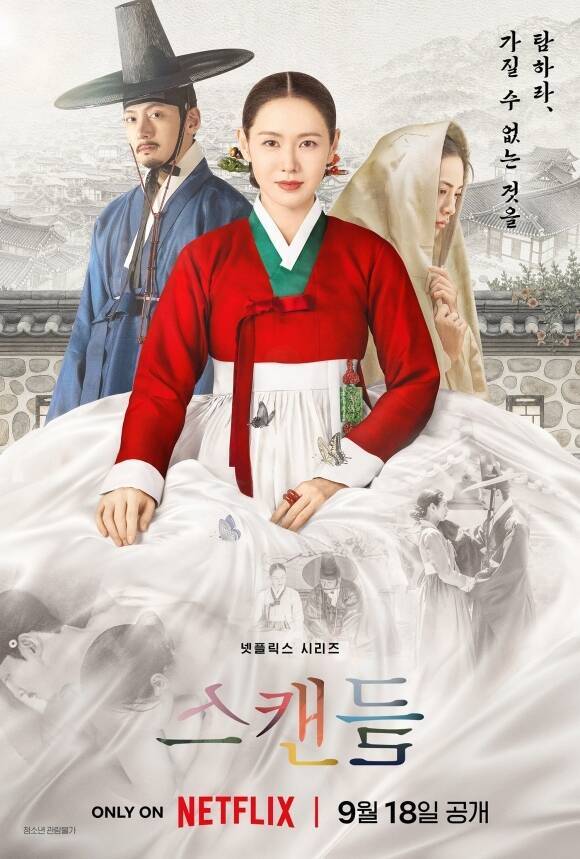 Starring Son Ye-jin&Ji Chang-wook&NanaA total of 8 episodes... All episodes released on the 18thNetflix's new series 'Scandal' released all 8 episodes on the 18th at 5 PM. The work depicts the story of Lady Jo (played by Son Ye-jin), a woman with exceptional talent who cannot be confined to life as a Joseon woman, Jo Won, Joseon's top Casanova, and the tragic love story entangled in their bet. /Netflix[THE FACT|Reporter Kim Saet-byul] Watching 'Scandal' makes you constantly step back. There are certainly intriguing characters, and stories yet to be revealed. Especially, the relationships surrounding the three main characters continue to pique curiosity. However, just as interest begins to build, the direction takes precedence, or even a step further, asserting its presence.Netflix's new series 'Scandal' (written by Lee Seung-young&Ahn Hye-song, directed by Jung Ji-woo) released all episodes worldwide today (18th) at 5 PM. Prior to this, Netflix provided reporters with the first 4 episodes of the 8-episode series through an advance screening.The work depicts the story of Lady Jo (played by Son Ye-jin), a woman with exceptional talent who cannot be confined to life as a Joseon woman, Jo Won (played by Ji Chang-wook), Joseon's top Casanova, and Hee-yeon (played by Nana), who is entangled in their bet. Episodes 1-4 gradually unveiled the relationships and pasts of the three characters, revealing the outline of the main conflict.What draws the most attention is, of course, the characters. Lady Jo is highly complex. She is independent and self-directed from a young age, but for some reason, she has walked a path different from her desires. She appears strong but seems lonely, and appears cold, yet ultimately offers kind words even to the concubine she did not want. Her conflicted choices reveal a complex inner self that cannot be explained by simple desires.Regarding Jo Won, Director Jung explained at the press conference that he cast Ji Chang-wook expecting to see his 'kind' side. Although it's ambiguous in the first 4 episodes, the kindness viewers expected is likely to be revealed in the latter half through his feelings for Lady Jo. What Lady Jo means to Jo Won, and why he persistently approaches Hee-yeon, remains to be seen.However, the process of seduction is a separate issue. It is questionable whether his actions of entering the other person's home, closing the distance, and pushing his will will be perceived as the charm of 'Joseon's top Casanova.' Even if Jo Won's true feelings and story are revealed in the latter half, his initial actions do not change. From today's perspective, there are moments that feel more like coercive advances than skillful seduction.Hee-yeon's narrative also sparks curiosity. How the connection between Jo Won and Lady Jo in their childhood will carry over to the present Hee-yeon, and how Jo Won will shake Hee-yeon's closed world, are also questions.Most importantly, the way the characters reveal their thoughts and philosophies through exchanging letters is intriguing. This is because the Joseon era setting is not merely used as decoration but as a device to connect the characters' relationships and worldview.The attempt to show Joseon's culture and sentiment is also noticeable. While the way the story opens using pansori from the first episode has been seen in other K-content like Netflix's film 'Gil Bok-soon', it is not an entirely new choice. Nevertheless, it is meaningful in that it shows a Korean aesthetic by combining the traditional element of pansori with modern cinematic language.Netflix's new series 'Scandal,' starring Son Ye-jin, Ji Chang-wook, and Nana, emphasized the relationships between characters but left disappointment with its direction, which took precedence over them. /NetflixHowever, it is regrettable that the device is repeated every episode. While it is understandable that pansori appears to explain scenes and characters' actions, it is repeated in almost every scene, and at some point, it feels less like a device to create the work's atmosphere and more like a device to constantly emphasize 'Koreanness.'It's not just pansori. The repetition of various directorial choices that highlight traditional mise-en-scène, colors, Joseon's philosophy, and culture makes it feel like the work is consciously trying to showcase the 'beauty of K-content.' Each element, on its own, is sufficiently attractive. However, when good devices are repeated and overlapped, one cannot help but question the intention.The director's excessive ambition is also evident in scenes that follow the characters' emotions. In scenes where Hee-yeon is standing, instead of focusing on the character's face and expression, the camera focuses on the surrounding text or patterns, and shifts its gaze to paintings. The intention to emphasize Joseon's aesthetic and the work's message is fully understandable. However, considering that all three lead actors are capable of directly conveying a character's emotions, was it really necessary to excessively focus on objects?Director Jung stated at the press conference that when adapting the original work into a series, he differentiated it by focusing on showing 'the narrative between characters.' Indeed, the most interesting part of the work is here. The long-standing relationship between Lady Jo and Jo Won, the new relationship between Hee-yeon and Jo Won, and the thoughts of the three people revealed through letters create curiosity about how they will intertwine in the future.However, the camera intervenes every moment the actors build that narrative through their performances. Ultimately, in a work that highlights 'the narrative between characters' as its distinguishing feature, there are moments when the direction overshadows the characters' emotions.The subplot is also disappointing. Whenever the stories of So-ok (played by Shin Yoon-ha) and Kwon In-ho (played by Chanhee) appear, the central narrative feels interrupted. Looking only at episodes 1-4, their scenes do not feel as compelling as the stories of the three main characters. We will have to wait and see what role their stories will play in the remaining episodes, but for now, it might have been better to allocate more time to the relationships of the main characters.Ultimately, 'Scandal' in episodes 1-4 leaves an impression that it has good ingredients and intriguing characters but doesn't fully trust them. The camera assigns meaning before the subtle nuances of the relationships created by the actors, and it tries to emphasize other things over the characters' emotions.Nevertheless, there are still lingering questions that prevent one from completely letting go. There is much that has not yet been revealed, such as why Lady Jo made that choice between love and family, what Jo Won's true feelings are that he is hiding, and what past Hee-yeon went through to be in her current position. In particular, the extent to which the theme of Joseon women's choices and agency will be expanded through Lady Jo and Hee-yeon is also a point of interest.sstar1204@tf.co.kr[Entertainment Department | ssent@tf.co.kr]
- HOT NEWS
- Jungkook 'GOLDEN' enters Spotify weekly chart for 149 weeks, longest entry—first solo in Asia to achieve this record
- CASI Convenes Global Sustainability Leaders in Hong Kong to Advance SME Transition Financing, Climate Adaptation, and Resilience
- Jang Wonyoung’s Latest Instagram Drop Is Pure Mystery
- CSTS Enterprises Appoints Carlos Pulido as the Regional Leader to Accelerate Global Sports Hospitality Growth
- Park Seo-jin forms trot running crew... 10km course & first place wins appearance on 'Mr. House Husband'


허블 정보
Copyright © 2017 Huvle All Rights Reserved
admin@huvle.com