
[TF Focus] Who is holding 'free festivals' and why?
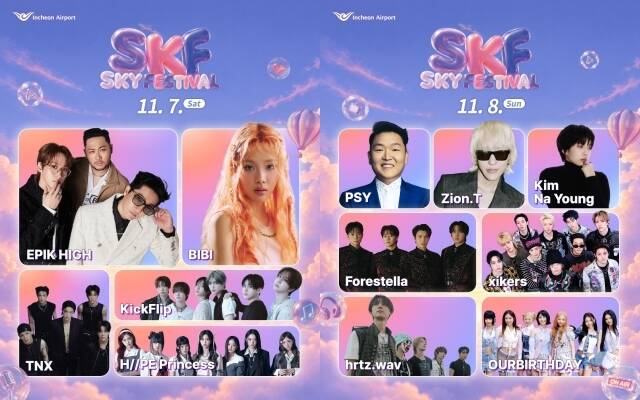 Most are hosted by public institutions or large corporationsSignificant promotional effect for the costThe Incheon International Airport Corporation will host the free festival '2026 Sky Festival' at Inspire Arena on November 7th and 8th. / Incheon International Airport Corporation[THE FACT|Reporter Choi Hyun-jung] With many festivals being held every year, there is growing interest in the increasing number of 'free festivals.'In October and November, several 'completely free festivals' are scheduled in the Seoul and Gyeonggi regions. First, the '8th Black Music Festival' will be held on the 16th and 17th at the outdoor stage of the Uijeongbu Arts Center in Uijeongbu City, Gyeonggi Province. Many artists who are very popular in the hip-hop scene, such as Zion.T, N.Flying, Giriboy, Sokodomo, DJ Vavo, Gray, Kim Seung-min, Noh Yun-ha, Fusion MC, and Panda Gomm, will perform at this event.Additionally, on October 24th, the '2026 Seoul Music Festival,' featuring artists like Paul Kim, Kwon Jin-Ah, Okdal, Nerd Connection, Choo Da-hye Band, and Kim Chang-wan Band, will be held at Nodeul Island in Seoul. On November 7th and 8th, the '2026 Sky Festival,' with performances by Epik High, Psy, Bibi, Zion.T, KickFlip, Hype Princess, xikers, hrtz.wav, TNX, and OurR, will take place at Inspire Arena in Yeongjong-gu, Incheon.All of these festivals are completely free. In addition to these festivals, various other 'free festivals' are held across the country each year, excluding local festivals.The question here is 'who,' 'why,' and 'how' are these festivals held for free. As a stark example, industry analysis suggests that hosting a festival of similar scale to the 'Sky Festival' would easily exceed 1 billion won in venue rental and artist appearance fees alone.In fact, according to the bid announcement for event agency services issued by the Incheon International Airport Corporation, the host of the '2026 Sky Festival,' the total project cost amounts to 2.1989 billion won.The secret to hosting a festival with such high costs for free is, of course, having a secure source of funding. Currently, all free festivals being held are hosted by public institutions or large corporations.For instance, the Uijeongbu Culture and Tourism Foundation is the host of the '8th Black Music Festival,' the Seoul Foundation for Arts and Culture for the '2026 Seoul Music Festival,' and the Incheon International Airport Corporation for the '2026 Sky Festival.' All of these are institutions established and funded by the city or public enterprises.Goh Ki-ho, president of the Korea Association of Music Performance Industry, explained, "All the free festivals currently being held are events directly hosted by public institutions or large corporations. They often have budgets allocated from the outset for promotional or other business purposes. For public institutions, it can be seen as a cultural return project for citizens or customers, and for corporations, it's appropriate to view it as part of their promotional marketing efforts."The Uijeongbu Culture and Tourism Foundation and the Seoul Foundation for Arts and Culture, which host the 'Black Music Festival' and the 'Seoul Music Festival,' respectively, are both institutions established and funded by their respective cities. / Uijeongbu Culture and Tourism Foundation, Seoul Foundation for Arts and CultureSo, the question arises again: 'Is the effect really worth it?' Naturally, if sufficient promotional marketing effects are not achieved, it becomes a 'loss' for corporations. In the case of events hosted by public institutions, since tax money, such as national subsidies, is mostly involved, it can easily become a target of significant criticism.In this regard, President Goh explained, "For example, if a festival attracts 10,000 attendees per event, direct product or policy promotion can be conducted for these customers. Also, attendees who agree to the use of their personal information can be utilized for future marketing. The ability to secure 'a definite 10,000 people' seems to be highly valued."As he said, unlike online visits where people usually stay for a few seconds to a few minutes, festival attendees are repeatedly exposed to brands for 4-5 hours through title sponsors, LEDs, booths, sampling, MC mentions, photo walls, F&B, and merchandise.Furthermore, according to a 2025 survey conducted by Freeman, a global event management company, and The Harris Poll, a market research firm, 95% of offline event attendees reported trusting the brand more after the event, 92% reported a positive impact on brand perception, and 87% expressed an intention for online interaction, such as visiting the brand's website afterward.In other words, companies and public institutions secure loyal customers through festivals. However, some voices have also warned against holding festivals too habitually.Yoon Dong-hwan, a member of the Cultural Arts Policy Advisory Committee directly under the Minister of Culture, Sports and Tourism, stated, "It is naturally a good thing for social costs to benefit citizens. However, in a situation where festivals are saturated, habitually holding new festivals, even if free, can lead to audience fatigue, a decline in quality, and negative perceptions of existing festivals. It would be good to strive to create well-made festivals, considering these points."He continued, "Also, since free festivals do not consider profits, there is a tendency to only invite famous singers. This creates a risk of taking audiences away from existing private festivals. Private festivals with reduced competitiveness end up cutting production costs, which leads to a vicious cycle of reducing opportunities for new artists. I hope this industrial structure is also considered."laugardagr@tf.co.kr[Entertainment Department | ssent@tf.co.kr]
- HOT NEWS
- Kim Yong Bin "Only know trot"... '1 Night 2 Days' and 'Infinite Challenge' are also unfamiliar
- "Assassin(s)" ranks number one at the box office for three consecutive weeks... surpasses 3 million cumulative viewers
- Citi Wealth Brings Together Global Investment Leaders and Clients at Wealth Symposium 2026
- Sola sits on the sofa wearing an off-shoulder sweatshirt and shares her cheerful concerns.
- Jennie captivates attention in a purple swimsuit during the 'One of Girls' stage at The Weeknd's Korea concert


허블 정보
Copyright © 2017 Huvle All Rights Reserved
admin@huvle.com