
[Kang Il-hong's Close-up] The Essence of the 'Assassin(s)' Controversy... Did They Sell History or the Movie?
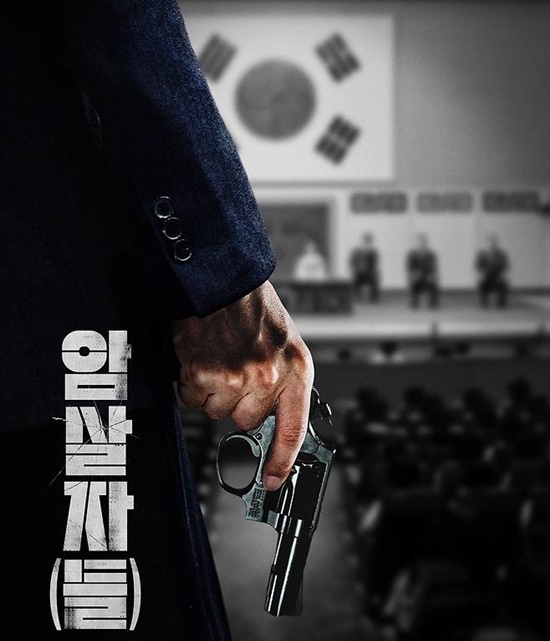 The commercial film's calculation hidden by 'cinematic imagination'... the boundary between reality and fictionThe mystery product 'star cameos mobilized' that 'historically questions' hinders immersionControversy surrounds 'Assassins'. The film, based on the assassination of First Lady Park Chung-hee on August 15, 1974, sparked political and social debate immediately after its release, with arguments over 'historical distortion' clashing with counterarguments of 'cinematic imagination'. / Still cut from the movie 'Assassins'[THE FACT|Reporter Kang Il-hong] Controversy surrounds the movie 'Assassins'. The film, based on the assassination of First Lady Park Chung-hee on August 15, 1974, sparked political and social debate immediately after its release, with arguments over 'historical distortion' clashing with counterarguments of 'cinematic imagination'. Some criticize it for exaggerating unconfirmed suspicions based on actual historical events, while others emphasize freedom of creation, stating it is merely a fictional film based on historical facts. Is the true essence of 'Assassins' solely about historical distortion?The movie does not recreate the '74 incident' as it happened. It reconstructs it as a mystery chase film by introducing fictional characters based on the questions surrounding the incident at the time. Instead of reconfirming the conclusion of the actual event, it asks the question, 'Could there have been another assassin?' and draws the audience into the process of investigation. Director Hur Jin-ho also said that he wanted to tell the story of those who pursued the truth, starting from the questions and limitations left in the records of the time, rather than reaching a final conclusion about the incident.The film transforms an event with historical weight into the genre of mystery, and features lead actors Yoo Hae-jin, Park Hae-il, and Lee Min-ho. In addition, familiar faces such as Jung Woo-sung, Park Jung-min, Shim Eun-kyung, Park Hae-joon, Oh Jung-se, Shin Hyun-been, Bae Seong-woo, Uhm Tae-woong, and Oh Dal-su make successive short special appearances. Why were so many star actors needed? The director said, "We needed actors who could bring weight to the roles, and I thought it would be enjoyable for the audience to see the actors."◆ "Too many star cameos are not good" They hinder immersionContrary to the director's intentions, a different effect occurs from the audience's perspective. When famous actors appear as cameos, the audience recognizes the actor before the character. Curiosity arises about 'Why is this actor here?', the presence of the character grows, and the buzz around the movie increases. In other words, the star casting itself becomes a cinematic device and simultaneously generates promotional effects. This is particularly evident in mystery genres like 'Assassins', which follow the clues of an event.Of course, it cannot be explained solely in positive terms. More cameos are not always better. They have the greatest effect when cast in the right place at the right moment by the right person. In fact, audience reactions to 'Assassins' are mixed. While some appreciate the appearance of familiar actors, others point out that the story's flow is interrupted by the successive short appearances of star actors, drawing attention to those actors. This can hinder immersion.◆ Mobilizing history and film, facts and imagination... the ultimate goal is 'commercial success'Furthermore, there is no need to overthink the answer to the question of whether it was intended for 'commercial success' from the outset. A film is ultimately a product that must draw audiences to theaters. Especially for a large commercial film released targeting the peak season of Chuseok, it is a very natural strategy to feature glamorous actors and genre entertainment. In fact, 'Assassins' highlighted its 'glamorous cast' as a key promotional point before its release and proved its public interest by surpassing 1 million viewers within four days of its release.Interestingly, famous stars were not cast as President Park Chung-hee and First Lady Park Chung-hee. Instead, stars were heavily featured in the fictional characters surrounding the historical event. This choice clearly shows the nature of the film. Historical figures are kept at a distance, while fictional characters around them attract audiences with the power of stars. It maximizes popular appeal between history and film, fact and imagination.The movie is not a history book, but once it takes material from history, it cannot remain solely in the realm of completely free imagination. 'Assassins' asks the question 'What is truth?' through the story of detectives and investigative reporters who pursued truth in an authoritarian era, maximizing the audience's curiosity and entertainment. / Still cut from the movie 'Assassins'◆ Intersection of actual records and cinematic fiction, possibility of confusing historical facts and creationFrom this perspective, there is no need to be confined to the simple dichotomy of the controversy surrounding the film, namely 'Is the movie distorting history or not?'. It is naturally possible to use fiction in a film based on a true story. Conversely, one cannot say, 'Since it's a movie, imagination is unlimited.' The moment historical events are reconstructed as mysteries, the film induces specific suspicions and emotions in the audience. Especially when actual records and cinematic fiction intersect, the possibility of confusing what is fact and what is creation is bound to increase.The core of the controversy lies in how far historical questions were expanded through cinematic imagination and how much that imagination was packaged as a popular product. 'Assassins' stands precisely on that boundary. Through the story of detectives and investigative reporters who pursued truth in an authoritarian era, it asks the question 'What is truth?', while simultaneously maximizing audience curiosity and entertainment by adding a glamorous lead lineup and numerous star cameos.The movie is not a history book, but once it takes material from history, it cannot remain solely in the realm of completely free imagination. This is especially true if the film becomes the first historical memory for the younger generation, who may not remember actual events from decades ago. Perhaps the biggest question 'Assassins' poses is not the identity of the assassin in the movie who remains an enigma. 'How do we remember history, and how does film recreate that memory?' The essence of the controversy lies here.eel@tf.co.kr
- HOT NEWS
- NOVI Health expands its longevity offering and grows its physician-led team
- Kim Yong Bin, Nam Seung-min announced to sing a song... laughter at the Trot Kitchen site
- 'Still Shining' Kim Hye-ja's Subtle Smile [TF Photo Studio]
- How Lee Junho Became the Quiet MVP of Netflix’s ‘Kian’s Bizarre B&B 2’
- Jung Woo-sung resigns from Artist Company internal director position... No change in 1.71 million shares held


허블 정보
Copyright © 2017 Huvle All Rights Reserved
admin@huvle.com