
[Kang Il-hong's Close-up] Park Jin Young, The Weight of 'Public Responsibility' Behind the 'K-Pop Glory'
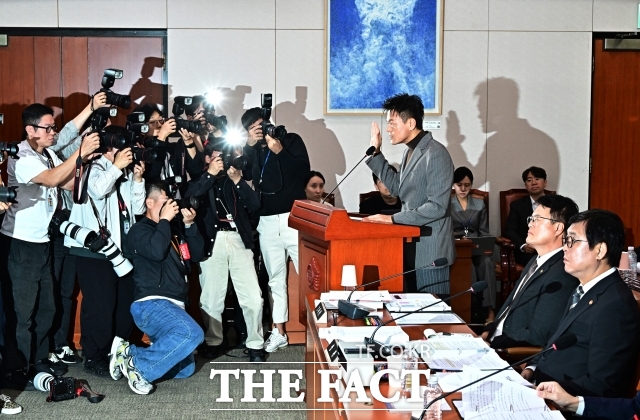 No pay, job performance expenses, and trademark disputes: the boundary between public interest and private gainThe role and responsibilities of private experts leading the globalization of K-pop... Transparency is also importantJYP head Park Jin Young attended a parliamentary audit of the Culture, Sports and Tourism Committee of the National Assembly in his capacity as co-chair of the Presidential Committee on Cultural Exchange. The photo shows co-chair Park Jin Young taking an oath as a witness at the parliamentary audit of the Ministry of Culture, Sports and Tourism held at the National Assembly in Yeouido, Seoul, on the afternoon of the 7th. / National Assembly = Reporter Bae Jeong-han[THE FACT| Reporter Kang Il-hong] The witness stand at a parliamentary audit is a somewhat unfamiliar stage in the entertainment industry. This is because it is not common for stars who have received applause for their singing, dancing, hit songs, and global achievements to suddenly face a barrage of questions from lawmakers. However, singer and JYP Entertainment representative producer Park Jin Young recently became the protagonist. This is because he attended the parliamentary audit of the Culture, Sports and Tourism Committee of the National Assembly in his capacity as co-chair of the Presidential Committee on Cultural Exchange.One of the controversies was the gap between the explanation of "unpaid service" and the receipt of approximately 2 million won per month in job performance expenses, and the other was the trademark issue of "Phenomenon," a global K-pop project promoted by the Committee on Cultural Exchange. Park Jin Young explained that he was unaware of receiving expenses, and stated that the trademark was a measure to protect the project, but the appropriateness of the process, public interest, and the possibility of preferential treatment for a specific company emerged as key issues.Of course, the mere fact that a controversy has arisen does not necessarily mean that private gain or illegality is being pursued. Park Jin Young acknowledged during the parliamentary audit that the trademark application process was not normal, but explained that he rushed due to concerns about the project being taken away. He also emphasized that it was not a project for the benefit of a specific company, as it was an event in which the four major entertainment agencies participated together.Nevertheless, the reason why this controversy is not trivial is separate. Park Jin Young is not just an entertainer, but a person entrusted with a public role connecting the government and the private sector. On stage, passion and achievements of the creator can be the standard for evaluation. However, in a public position, passion alone is not enough. One must be able to explain the execution of budgets and expenses, decision-making for projects, prevention of conflicts of interest, and the attribution of achievements and responsibilities.Regarding the receipt of approximately 2 million won per month in job performance expenses, Park Jin Young explained, "I was unaware of receiving expenses," and stated, "The trademark was a measure to protect the project," but the appropriateness of the process, public interest, and the possibility of preferential treatment for a specific company emerged as key issues. / National Assembly = Reporter Bae Jeong-han◆ The more influential the person, the higher the level of explanation and responsibility requiredIf there was goodwill for the public interest, proving that goodwill through systems and procedures is the starting point of public responsibility. In particular, the term "unpaid" should be handled more carefully. Not receiving a salary is a different concept from receiving support necessary for performing public duties, such as job performance expenses, travel expenses, and support staff. Job performance expenses cannot be directly equated with salary. However, if there is room for misunderstanding between the explanation given to the public and the actual support provided, there is a responsibility to resolve it.The experience and expertise that Park Jin Young has accumulated in the K-pop industry are undeniable. As someone who has directly led the process of Korean popular music competing in the global market, he knows the realities of the industry and strategies for overseas expansion better than anyone else. This is likely why the government seeks to utilize the capabilities of private experts. It is a meaningful attempt for individuals who understand the field to participate in the planning stage of policy.However, acknowledging expertise and exempting verification of public authority are entirely different matters. Rather, the more influential the person, the higher the level of accountability is required. If a specific company participates in the planning and execution of a public project, the contract structure, decision-making authority, ownership and transfer of intellectual property rights, and profit distribution principles must be clearly disclosed from the outset. It is not enough to just consider whether a conflict of interest has actually occurred; it must also be shown how the possibility of a conflict of interest has been blocked.The explanation that "Phenomenon" will be promoted primarily with private funds without direct government investment does not resolve all doubts in itself. If a public institution plans a project and the government and private sector cooperate, not only the source of funds but also the public nature of the project, the selection criteria for participating private companies, and the attribution of trademarks and profits must be comprehensively verified. Public responsibility does not decrease simply because it is a privately led project. Conversely, it cannot be concluded that it is preferential treatment simply because private expertise and capital were utilized.◆ Public trust in public interest projects is achieved through principles, procedures, and accountabilityThis is also why the current issue should not be consumed solely as political infighting or a debate about the sincerity of a star. Those who defend Park Jin Young may think that private experts dedicating themselves to the national cultural industry are being overly pressured. Those who criticize may argue that projects that claim to be for the public interest require stricter verification. Rather than unconditionally rejecting the issues raised by both sides, it is a productive approach to verify them through actual data and institutional mechanisms.K-pop has now become a cultural asset that determines Korea's image and industrial competitiveness, beyond just a music genre. As its influence grows, the transparency of the policies and projects that support it must also increase. A star's recognition can help promote a project, but that recognition cannot replace public verification. Public trust is not built solely on belief in the goodwill of celebrities. It is only completed when there are principles that apply to everyone, open procedures, and an accountable attitude when problems arise.Although this parliamentary audit may have been an uncomfortable stage for Park Jin Young, if the cultural project he is pursuing is truly for the next leap forward in Korean popular culture, the process of resolving suspicions and making the operating structure transparent can be an opportunity to enhance the project's credibility. What is important is not to repeatedly emphasize how sincere he was, but to show what measures have been put in place to ensure that his sincerity does not conflict with private interests.It is an era where public interest is spoken in the name of stars. If so, responsibility befitting the name of a star must follow. Borrowing private capabilities for the globalization of K-pop is necessary. The problem is that from the moment public interest is claimed, the project can no longer be explained solely by the goodwill of individuals or companies. The question left by the 'Park Jin Young controversy' is clear: 'What must a star leading K-pop's success prove to be trusted in the public sphere?' The answer lies not in brilliant performances or heated explanations, but in transparent procedures and responsible results.eel@tf.co.kr
- HOT NEWS
- 2026 Miss Korea Winner Woo Seo-yoon's Thoughts Amid Plastic Surgery Rumors: "A Valuable Experience... I Won't Be Hurt"
- 'I Live Alone' Denies Scripted Episode Rumors... "It's a production plan to facilitate filming"
- Bybit Renews RLUSD Hold & Earn Phase 4 with 1.3 Million XRP Rewards and Zero Fee
- CORTIS actively communicates with fans with a bright smile...capturing a warm and friendly atmosphere
- Gary, son Hao's recent attendance at the sports day... surprise reveal on family SNS



허블 정보
Copyright © 2017 Huvle All Rights Reserved
admin@huvle.com