[The Era of Collaboration 2] Different Perspectives, One Piece of Work... The Changing Landscape of Global Collaboration
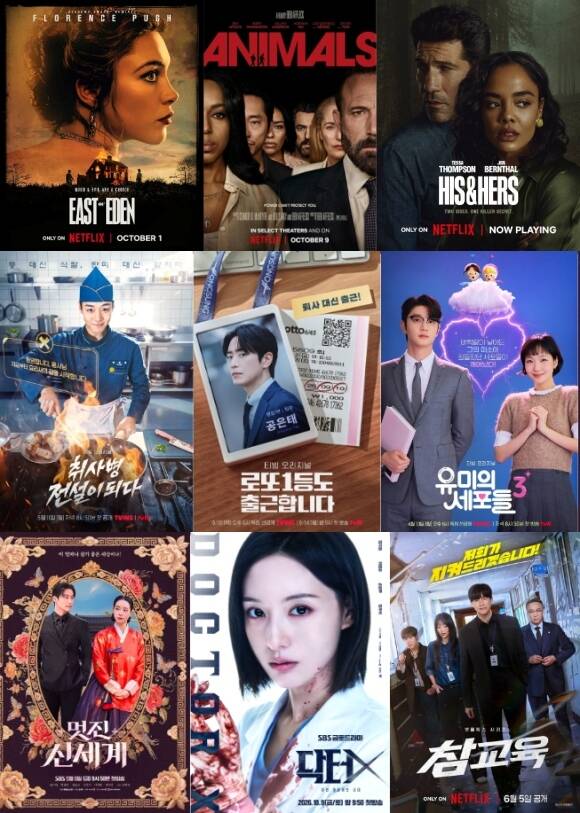
Expanding Overseas Partnerships... Collaboration Extends Beyond Production Costs to Planning and Creative RealmsCombining the Perspectives of a Multinational Production Team... Coordinating Language, Culture, and Work Styles Poses a ChallengeCJ ENM has announced its goal to secure intellectual property (IP) with high box office potential by collaborating with Japan, the U.S., and other countries, leveraging their respective production and distribution bases, and nurturing them into large-scale IPs that can generate long-term revenue. /CJ ENMAs K-drama production costs rise and the investment environment for global OTT services changes, domestic production companies are seeking new production methods. One such method is 'global co-production,' which involves collaboration with overseas production companies and platforms. Cases of sharing production costs and jointly pursuing entry into local markets with various countries, including Japan, the U.S., and Thailand, are increasing. Amidst the changing landscape of K-drama production, this article examines the current state of global co-production, the challenges faced on-site, and future tasks.
[THE FACT|Reporter Kim Saet-byul] As global co-production establishes itself as a new production method for K-dramas, changes are emerging in the planning and production environments of domestic companies. While new possibilities are opening up by combining different production capabilities and perspectives, the process of aligning the opinions of production teams from each country to complete a single work has also become crucial.Global co-production typically involves production entities from multiple countries participating together in the planning, development, and production processes. In the past, the primary form was selling completed content overseas or exporting remake rights. However, recently, there has been an increase in projects that involve collaboration with overseas partners from the initial planning stages. This differs from previous overseas expansion methods in that the direction of the work is set together, and content is developed considering the production environment and market of each country.This change has been influenced by the shrinking domestic content market and the overseas success of Korean works through global OTT services. With the domestic market contracting since COVID-19, and Korean content proving its competitiveness in the global market, production companies are actively seeking overseas production and collaboration.An official from a production company that participated in global co-production, identified as Person A, stated, "I believe the biggest reason is the contraction of the domestic market after COVID-19. At the same time, as we've seen Korean works receive real-time love worldwide through global OTT services, I think we've become more proactive in pursuing overseas production from a business perspective."On the other hand, some argue that the results are only now beginning to become prominent, even though many production companies have been consistently attempting overseas production for a long time.The attitude of domestic production companies towards overseas partnerships is also changing. They view it not only as a practical benefit of sharing production costs or securing local distribution networks but also as an opportunity to realize plans and scales that would have been difficult to attempt with domestic solo production.Another production official, Person B, pointed out, "When overseas capital is involved, there can be changes in the production environment and the completeness of the work. It is a significant advantage that we can complement the elements needed for the work by combining the technologies and production capabilities of production companies from each country, and consider technological options that were not previously utilized."He added, "It might sound cliché, but the power of capital is a definite merit. If you have more money, the production environment and quality inevitably change."Person A echoed a similar sentiment, saying, "The fundamental way of producing movies or dramas is not significantly different domestically and internationally." However, he noted, "The meaningful advantage is the unique and fresh synergy that arises when elements from different cultures, such as directing styles and actor performance tones, naturally blend together, creating something that couldn't be seen in previous solo productions."He further explained, "We determined that Korea's production know-how doesn't necessarily have to be confined to Korean acting and Korean settings. In our case, the initial planning direction and core objective were the conviction that we could develop the story much more interestingly by changing the setting while retaining the unique charm of the original overseas film."'The Gasman' and 'Romantic Anonymous' are K-Japanese co-productions in which Korean production staff participated, and they were released on Netflix Japan, receiving much love locally. /NetflixIn actual co-production processes, there are instances of sharing each other's production methods and embracing new approaches. In the case of Netflix's 'The Gasman,' written by director Yeon Sang-ho and directed by director Shinzo Katayama, director Katayama introduced and applied Korea's on-site editing and immediate sharing system to the filming in Japan.Broadcasting official Person C commented on this, saying, "Above all, isn't this proof that Korean content is being recognized overseas? The increase in global co-productions means that trust in Korean content has grown, and it implies that it is considered worth investing in overseas."However, as the number of participating entities increases, the process of unifying the creative direction also becomes necessary. The elements that production teams from each country consider important may differ, and opinions can diverge on how to reflect the tastes of local viewers. Instead of unilaterally imposing one perspective, it is crucial to share the core planning intent of the work and find common ground where each party can leverage their strengths.These differences also manifest on the actual production set. As multinational staff and cast work together from script development and reading to filming, considerations must be given not only to language but also to cultural backgrounds and work style differences. It is also necessary to accurately convey the intentions and emotions of characters embedded in the script and to share an understanding of the directing approach and scenes.Consequently, some production companies have conducted workshops before filming and invested significant effort in script readings. This was because, when overseas directors and actors were to direct and act based on scripts planned and written by Korean creators, it was important to minimize subtle nuances arising from language and cultural differences.Person B stated, "We inevitably have to invest a considerable amount of time and effort in the reading stage to enhance mutual understanding on set."On the filming set, practical aspects such as production schedules, division of labor, and communication methods among staff must also be aligned. This is because the methods considered familiar in the production environments of each country can differ. Sharing roles and work standards sufficiently from the planning stage and establishing a communication system that allows for the exchange of opinions on-site form the basis for smooth collaboration.Platform official Person D revealed, "It is standard to have three to four interpreters for each language on the script reading set. On the other hand, there can be minor and major friction during the process of coordinating the production direction because the authority and judgment criteria that producers or directors can exercise on-site differ between the two countries."Ultimately, the significance of global co-production lies not in the participation of overseas partners themselves but in how effectively their different production capabilities are combined within the work. The advantages of collaboration can only translate into concrete results when the planning capabilities, local understanding, and production experience of both parties are organically intertwined.In this way, global co-production is opening up new possibilities for planning and creation for domestic production companies. However, sufficient communication and coordination must be provided to connect different production environments and perspectives into a single work. [The Era of Collaboration 1] K-Dramas Breaking Borders... Will Co-Production Become a New Survival Strategy?[The Era of Collaboration 3] 'Dilution of Identity' and 'IP Dominance'... Challenges of Global Co-Productionsstar1204@tf.co.kr[Entertainment Department | ssent@tf.co.kr]