
The Korea Music Content Industry Association expressed regret over the US NYT's report on the 'NewJeans contract'
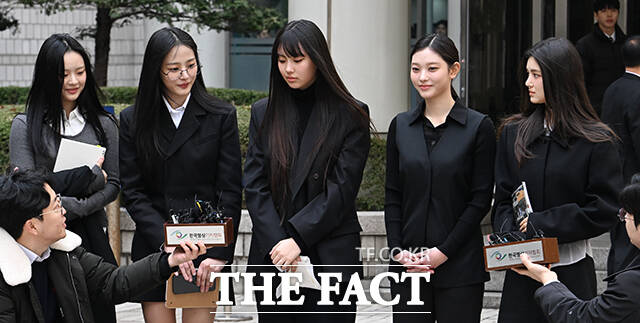 New York Times Reports "Unusually Restrictive Contract"KMCIA Counters with "One-Sided and Biased Assessment"Amidst a recent report by The New York Times characterizing the exclusive contract of NewJeans as "unusually restrictive," the Korea Music Content Industry Association (KMCIA) expressed regret, stating it was a "one-sided and biased assessment that fails to adequately consider the unique characteristics and value of the system." The photo shows members of NewJeans attending court last March. / THE FACT DB[THE FACT | Reporter Jung Byung-geun] The Korea Music Content Industry Association (KMCIA), headed by Chairman Woo Seung-hyun, has expressed regret over a recent New York Times (NYT) report on the exclusive contract of NewJeans.In an official statement released on the 9th, the KMCIA stated, "We express deep concern regarding the report that cited the exclusive contract of a specific K-pop artist. We believe this is a one-sided and biased assessment that not only fails to adequately consider the legality and legitimacy of contracts made under Korean law and institutional regulations but also overlooks the unique characteristics and value of the incubation system that has contributed to K-pop's growth into a global industry."The association further stated, "The protection of artists' rights and the respect for the legitimate rights of producers are not conflicting values. The rights of minor artists must be guaranteed. At the same time, the legitimate investments and contractual rights of producers must also be protected. The K-pop industry has grown based on the long-term investments of companies and the creative activities of artists. Legally executed contracts and judicial decisions must be respected. K-pop companies are already taking various measures legally for teenage trainees and active artists."The KMCIA also expressed deep concern about the situation where the exclusive contract, which is subject to a confidentiality obligation between the parties involved in the ongoing legal dispute, has been disclosed through foreign media, leading to the spread of one-sided claims and public opinion manipulation. "We must be wary of individual disputes leading to a negative assessment of the entire K-pop industry," the association emphasized, adding, "We will resolutely respond to prevent distorted public opinion campaigns that damage the credibility and status of the entire industry, as well as inappropriate actions pursued for private gain."Previously, on the 5th (local time), The New York Times reported that it had obtained the exclusive contract signed in 2022 by five members of NewJeans when they were between the ages of 14 and 17, claiming it was an "unusually restrictive contract." The key issues highlighted by The New York Times in the exclusive contract include the deletion of clauses for the protection of minors' rights and the method of calculating penalty fees for contract termination.Following the report, HYBE refuted The New York Times' claims, stating, "Labels under HYBE have entered into supplementary agreements with all their trainees, based on the national standard for youth. These supplementary agreements include protective clauses for personality rights, sleep rights, education rights, and rest rights." HYBE also raised suspicions that someone may have intentionally leaked the contract.Meanwhile, NewJeans members and ADOR, a label under HYBE, experienced an exclusive contract dispute in 2024. The court ruled that the exclusive contract was valid, siding with ADOR. Subsequently, HAERIN, HYEIN, and HANNI among the NewJeans members returned to ADOR, while MINJI is in discussions for their return.However, ADOR notified member Danielle of the termination of her exclusive contract in December of last year and filed a lawsuit for damages amounting to approximately 33.1 billion won against Danielle and Min Hee-jin, the former CEO of ADOR, in April. ADOR claims that Danielle and Min Hee-jin bear significant responsibility for NewJeans's departure and delayed return.The following is the full statement from the Korea Music Content Industry Association regarding The New York Times' report on K-pop exclusive contracts.The Korea Music Content Industry Association (KMCIA), headed by Chairman Woo Seung-hyun, expresses deep concern regarding the recent report by The New York Times (NYT) that cited the exclusive contract of a specific K-pop artist. We believe this report not only fails to adequately consider the legality and legitimacy of contracts made under Korean law and institutional regulations but also presents a one-sided and biased assessment that overlooks the unique characteristics and value of the incubation system that has contributed to K-pop's growth into a global industry.The K-pop industry, now lauded worldwide, is a collaborative achievement of entertainment agencies and artists. This is institutionally supported by the 'Standard Contract for Popular Culture and Arts' and the 'Act on the Development of the Popular Culture and Arts Industry,' enacted by the Korean government. These two systems protect agencies that invest substantial amounts while bearing the risk of loss, and simultaneously uphold and guarantee the rights of artists, who can be relatively vulnerable, embodying balanced principles. Currently, all domestic entertainment companies and artists respect the spirit of this standard contract and work together under the regulations of the Act on the Development of the Popular Culture and Arts Industry to draft, execute, and grow through contracts. The numerous contract renewals of artists whose contract periods have expired serve as proof of this. Thus, the issue of protecting artists' rights has been a significant task to which K-pop companies and the Korean government have continuously paid attention and made efforts to achieve institutional and practical improvements.Nevertheless, we express regret that The New York Times has expanded the controversy surrounding a specific individual contract into a structural problem of the entire K-pop industry, without adequately highlighting these institutional developments and the industry's self-regulatory efforts. The fairness and legality of exclusive contracts must be judged by comprehensively considering not only individual clauses but also supplementary agreements, relevant laws and regulations, the circumstances of contract execution, and actual performance. Otherwise, there is a risk of spreading distorted perceptions of the K-pop industry and unfairly damaging the achievements and trust accumulated by the industry over a long period.The protection of artists' rights and the respect for the legitimate rights of producers are not conflicting values. The rights of minor artists must be guaranteed. At the same time, the legitimate investments and contractual rights of producers must also be protected. The K-pop industry has grown based on the long-term investments of companies and the creative activities of artists. Legally executed contracts and judicial decisions must be respected.K-pop companies are already taking various measures legally for teenage trainees and active artists. Major K-pop companies, including HYBE, have entered into supplementary agreements with trainees based on the national standard for youth, which include protective clauses for personality rights, sleep rights, education rights, and rest rights. Furthermore, major K-pop companies affiliated with the association have designated youth protection officers in accordance with relevant laws and have been managing related matters.The K-pop incubation system is a talent development framework with unique characteristics and competitiveness that cannot be judged solely from a Western perspective. Major K-pop companies operate multifaceted care programs, even employing professional medical staff internally, to meticulously protect artists' health and personality rights. This dedicated management and pre-investment system is a unique industrial ecosystem in Korea that should not be disparaged as 'oppressive control.' It is within this ecosystem that world-renowned boy groups and girl groups, celebrated by people worldwide today, have been born, and countless trainees are sweating with dreams of becoming tomorrow's K-pop stars.Finally, the Korea Music Content Industry Association expresses deep concern about the situation where the exclusive contract, which is subject to a confidentiality obligation between the parties involved in the ongoing legal dispute, has been disclosed through foreign media, leading to the spread of one-sided claims and public opinion manipulation. We must be wary of unconfirmed claims or one party's perspective being accepted as objective fact, or individual disputes leading to a negative assessment of the entire K-pop industry.The Korea Music Content Industry Association will do its utmost to protect artists' rights and establish a sound contractual order so that the K-pop ecosystem can continue as a robust 'system' that is not shaken by external distorted views or the deviations of specific individuals. At the same time, we will resolutely respond to prevent distorted public opinion campaigns that damage the credibility and status of the entire industry, as well as inappropriate actions pursued for private gain.kafka@tf.co.kr[Entertainment Department | ssent@tf.co.kr]
- HOT NEWS
- Xinhua Silk Road: RVs from E China's Rongcheng gain popularity abroad
- Shin Min-a-Ju Ji-hoon, the perfect empress and emperor of the Great Empire [TF Photo Studio]
- Jeong Jinwoon 'First Fantasy Romance Challenge' [Photo]
- Saigon Technology: Why Businesses Fear Modernizing Software in the AI Era
- [Kang Il-hong's Close-up] 'Global Status' K-POP, Who Will Protect the Fans' 'Trust'?

허블 정보
Copyright © 2017 Huvle All Rights Reserved
admin@huvle.com